




If I want to start kitchen work fast, a GI Bill®-approved culinary certificate is often the shorter path. If I want management or business roles, a college degree usually gives me more options.
Here’s the short version:
- Certificate programs often take 6–9 months
- Associate degrees often take about 2 years
- Bachelor’s degrees often take about 4 years
- Public in-state colleges are often covered in full by the Post-9/11 GI Bill®
- Non-college degree culinary programs may fall under a yearly VA tuition cap
- MHA depends on enrollment level, and for clock-hour programs, weekly hours can change what I get
- In high-cost Northeast cities, rent may still run past MHA
So the choice usually comes down to 3 things:
- How fast I want to finish
- How much I may need to pay out of pocket
- What kind of job I want after school
Some veterans want a direct path into jobs like line cook, prep cook, or pastry assistant. Others want a degree that may help with jobs like food service manager, restaurant owner, or hospitality manager. Both paths can work, but the GI Bill® does not always pay them the same way.
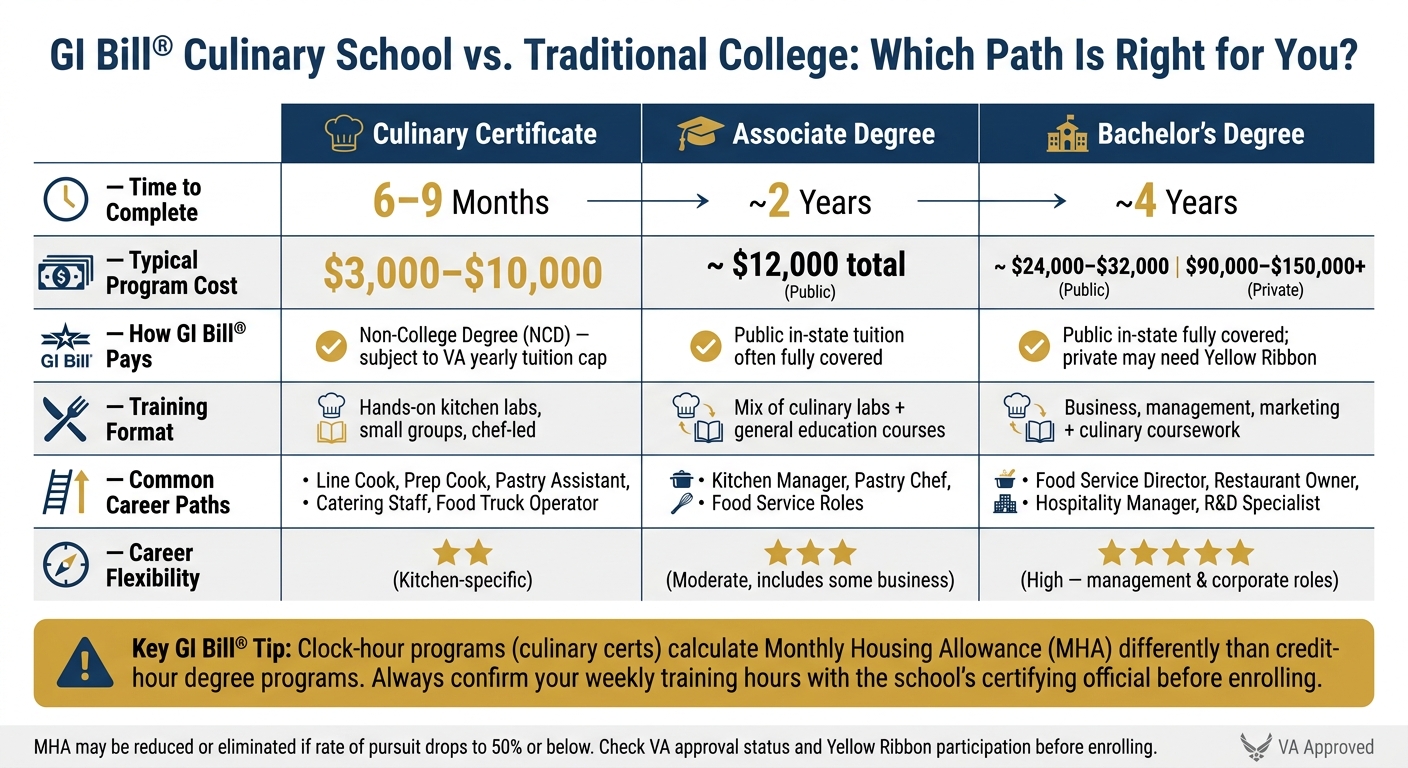
GI Bill® Culinary School vs. College Degree: Veterans’ Path Comparison
Veterans at the CIA: Why Food is their Perfect Career
sbb-itb-7261261
Quick Comparison
| Path | Usual Length | Typical Cost | How GI Bill® Pay Works | Common Jobs |
|---|---|---|---|---|
| Culinary school certificate | 6–9 months | Often $3,000–$10,000; some go higher | Often treated as non-college degree training, which may be subject to a VA yearly cap | Line cook, prep cook, pastry assistant, catering staff |
| Associate degree | About 2 years | Public schools around $12,000 total | Public in-state tuition is often fully covered | Kitchen manager, pastry chef, food service roles |
| Bachelor’s degree | About 4 years | Public schools about $6,000–$8,000 per year; private schools can be much more | Public in-state tuition is often fully covered; private schools may leave a gap unless Yellow Ribbon helps | Hospitality manager, food service director, restaurant owner |
A few numbers stand out. One GI Bill®-eligible culinary school listed certificate prices from $6,260 to $9,990. And one full-time clock-hour cohort ran at 22.5 hours per week, while a 13.5-hour cohort was part-time. That matters because part-time training can cut MHA, and if my rate of pursuit drops to 50% or less, I may not get MHA at all.
Before I enroll, I’d want to check:
- whether the program is VA-approved
- whether it uses clock hours or credit hours
- my actual weekly training hours
- whether tuition goes past what the VA will pay
- whether the school offers Yellow Ribbon
- whether I can get credit for military training, CLEP, or DSST
This guide breaks down financing culinary school, timing, housing pay, and job paths so I can compare both routes in plain English.
How GI Bill® benefits apply to culinary schools and colleges
The Post-9/11 GI Bill® can help with tuition and fees, pay MHA, and add up to $1,000 per year for books and supplies. But the part that often changes the math is how a school reports enrollment.
Tuition, housing, and book stipends under GI Bill® programs
Under the Post-9/11 GI Bill®, public in-state schools have tuition and fees covered in full. Many culinary certificate programs, though, are treated as non-college degree (NCD) programs. Those programs fall under the VA’s annual tuition cap.
That matters for one simple reason: if the program costs more than the cap, the veteran has to pay the rest out of pocket. Yellow Ribbon may help cover that gap at schools that take part in the program [1]. It’s smart to check that before you enroll so you don’t get hit with costs you weren’t expecting.
The book and supply stipend applies to both types of programs, and it’s prorated based on enrollment intensity.
This is where the split between clock-hour training and credit-hour degrees starts to matter.
Clock-hour culinary programs vs. credit-hour degree programs: how GI Bill® payments differ
Most colleges use credit hours. In many cases, 12 credits per semester counts as full-time. Culinary certificate programs often work differently and use clock hours instead.
The VA uses rate of pursuit to figure MHA, and full-time is usually about 18 to 22 clock hours per week [2].
At Park City Culinary Institute, the 22.5-hour morning cohort counts as full-time, while the 13.5-hour evening cohort is usually part-time and will often mean lower MHA [2]. And if your rate of pursuit is 50% or less, MHA usually doesn’t apply [2].
Before you estimate your monthly housing payment, ask the school’s certifying official one direct question: How many clock hours are reported each week? That one detail can change your benefit amount in a big way, especially if you’re comparing a full-time schedule with a part-time one.
Once you know how the VA pays for each path, the next step is figuring out which option gets you into the job market faster.
GI Bill® culinary schools: faster training, hands-on learning, and quicker job entry
Culinary certificate programs put you in the kitchen fast. Instead of spending years on general coursework, you spend most of your time practicing knife skills, sauces, and baking in kitchen labs. The scope is tight by design, and that’s what lets these programs wrap up in months instead of years.
Program length, costs, and what GI Bill® may cover
Culinary certificate programs often run 6 to 9 months, compared to 2 to 4 years for a college degree [1][4]. For many veterans, that shorter timeline means getting into paid kitchen work sooner.
Park City Culinary Institute offers on-campus GI Bill®-eligible certificate programs at these prices [2]:
- Professional Certificate in the Culinary Arts (216 hours of instruction): $9,990
- Cuisine Certificate: $6,840
- Pastry & Baking Certificate: $6,260
Those prices sit well below the top end of the certificate market [4].
Training format and career outcomes at culinary schools
At culinary schools, the training format is hands-on and built around small groups [3]. Students work in kitchen labs with experienced chef instructors instead of spending most of the day in lecture rooms [3]. Park City Culinary Institute offers an ACF-approved curriculum [3].
After finishing, graduates often step into roles like line cook, prep cook, pastry assistant, catering staff, or food truck operator [1][3].
That fast path is the main tradeoff. You get to work sooner, while the degree route gives you a broader academic path to compare against.
Summary table: GI Bill® culinary school costs, training format, and entry-level roles
For veterans who want fast job entry, these are the facts that matter most.
| Feature | GI Bill® Culinary School (Certificate) |
|---|---|
| Program Length | 6–9 months [4] |
| Tuition Range | $2,000–$30,000; Park City Culinary Institute from $6,260 [2][4] |
| Class Format | Small-group kitchen labs, chef-led instruction [3] |
| Credential | Professional Certificate [3] |
| Common Entry-Level Roles | Line Cook, Prep Cook, Pastry Assistant, Catering Staff, Food Truck Operator [1][3] |
The faster route gets you into the kitchen sooner. The college path offers a different return, with more range in what you study and where it may lead.
Traditional colleges: broader degrees, longer timelines, and management career paths
Traditional colleges combine culinary training with general education, business, nutrition, and management. That gives you a broader degree path, but it also means more time in school and, in most cases, a higher price tag. For veterans who want to move past entry-level kitchen jobs, that extra range can matter.
Degree structure, total cost, and how GI Bill® benefits apply
An associate degree usually takes about two years. A bachelor’s degree usually takes about four years, or about two more after finishing an associate. At a public community college, an associate degree can cost about $12,000 total [5]. A public university bachelor’s program usually costs about $6,000 to $8,000 per year for in-state students [6].
Private colleges are a different story. Total bachelor’s costs can climb to about $90,000 to $150,000+ [5]. That’s a big jump.
For veterans, GI Bill® benefits cover full tuition at public in-state schools. Private colleges work under the annual national cap, so your costs may not be fully covered. Before you enroll, check whether the school takes part in the Yellow Ribbon Program. That step can help you avoid surprise out-of-pocket costs [1][4].
Some colleges also accept military training, plus CLEP or DSST credits. That can cut down the time it takes to finish your degree and lower the total cost [1].
Career paths beyond the kitchen
The main upside here isn’t just earning a degree. It’s where that degree can take you.
Bachelor’s programs often include subjects like business administration, marketing, logistics, and management. Those courses line up well with jobs such as Food Service Director, Restaurant Owner, or Hospitality Manager [1]. In plain terms, you’re not only learning how to cook. You’re also learning how to run teams, handle operations, and think about the business side of food.
Some schools also offer a culinary science track. That path mixes food science with culinary arts and can lead to roles in product development and research [1]. For veterans aiming at leadership, ownership, or corporate food service, the degree route often makes more sense than a shorter skills-only program.
Comparison table: traditional college costs, degree length, and career range
Here is the degree path at a glance.
| Degree Type | Time to Complete | Approx. Public Cost | Approx. Private Cost | Common Career Paths |
|---|---|---|---|---|
| Associate Degree | ~2 Years | About $12,000 total [5] | $30,000–$60,000 [5] | Line Cook, Pastry Chef, Kitchen Manager [1] |
| Bachelor’s Degree | ~4 Years | About $6,000–$8,000 per year [6] | $90,000–$150,000+ [5] | Food Service Director, Restaurant Owner, Hospitality Manager [1] |
| Culinary Science (BS) | ~4 Years | Varies | Varies | Food Technologist, R&D Specialist [1] |
GI Bill® culinary schools vs. traditional colleges: choosing the right path
Side-by-side comparison for veterans
Once you account for funding rules and program length, the choice usually comes down to how fast you want to start working, how much ground you want to cover, and where you want your career to go.
| Feature | GI Bill® Culinary School (Certificate) | Traditional Culinary Degree (Associate) | Bachelor’s in Hospitality Management |
|---|---|---|---|
| Time to Complete | 6–9 months [4] | ~2 years [5] | ~4 years [5] |
| Total Program Cost | Often $3,000–$10,000 [4] | Public: ~$12,000 total [5] | Public: ~$24,000–$32,000; private: $90,000–$150,000+ [5] |
| Career Flexibility | Specific to kitchen skills | Moderate; includes some business | High; applicable to corporate and management roles |
A certificate can get you into a kitchen fast. An associate degree takes longer, but it usually gives you more than knife skills. You also pick up some business and restaurant operations knowledge. A bachelor’s degree is the longest route, but it opens more doors outside day-to-day kitchen work, especially for management and corporate hospitality roles.
Northeast region: living costs and what they mean for your GI Bill® housing allowance
This tradeoff gets tougher in the Northeast, where housing can eat up a big chunk of your benefits. Your Monthly Housing Allowance (MHA) is tied to your school’s ZIP code, so schools in high-cost areas often come with higher rates. Still, in places like New York or Boston, rent can outpace what the MHA covers [4].
That gap matters. A school may look covered on paper, then turn into a budget problem once rent, food, and transportation hit all at once. If you’re looking at a private school in the region, check Yellow Ribbon Program participation before you enroll. That simple step can help you avoid surprise out-of-pocket costs [1].
Conclusion: What veterans should check before enrolling
Before signing up, it helps to slow down and check a few things first:
- Confirm the program is VA-approved, and make sure you know whether it uses clock hours or credit hours, since those are funded differently.
- Figure out your actual out-of-pocket cost after GI Bill® benefits, not just the posted tuition.
- Ask whether the school gives credit for military experience. Schools like Nicholls State University and the University of Alaska Fairbanks award college credit for service, which can shorten your timeline and cut total cost [1].
If your goal is to get into a kitchen as soon as possible, a short certificate program may make more sense. If you want management roles, future ownership, or more room to move across the industry, a degree usually gives you a longer runway.
FAQs
Which path gives me the best GI Bill® value?
To get the best GI Bill® value, pick a program that’s fully approved for your learning goals. Benefits can change based on the school and how the program is delivered.
At Park City Culinary Institute, the GI Bill® applies to on-campus professional certificate programs in Culinary Arts, Pastry & Baking, and Cuisine. Online options aren’t covered right now, so it’s smart to confirm VA approval before you enroll.
How do clock hours affect my housing allowance?
Under the Post-9/11 GI Bill, your monthly housing allowance depends on your enrollment status. For clock-hour programs, that status is based on the number of clock hours you attend each week.
The Department of Veterans Affairs uses those weekly hours to figure out your rate of pursuit. In plain English, the more clock hours you attend, the higher your enrollment level is likely to be. And that can mean a larger monthly housing allowance.
Can I start with a certificate and earn a degree later?
Yes. A lot of students start with a culinary arts certificate so they can get into the field sooner. Later, they may come back for an associate’s, bachelor’s, or master’s degree.
At Park City Culinary Institute, there’s also a more flexible path. You can begin with individual program sections instead of jumping straight into the full program. For example, you might complete Cuisine or Pastry & Baking first, start building your skills, and then return later to finish the full Professional Certificate in Culinary Arts.