
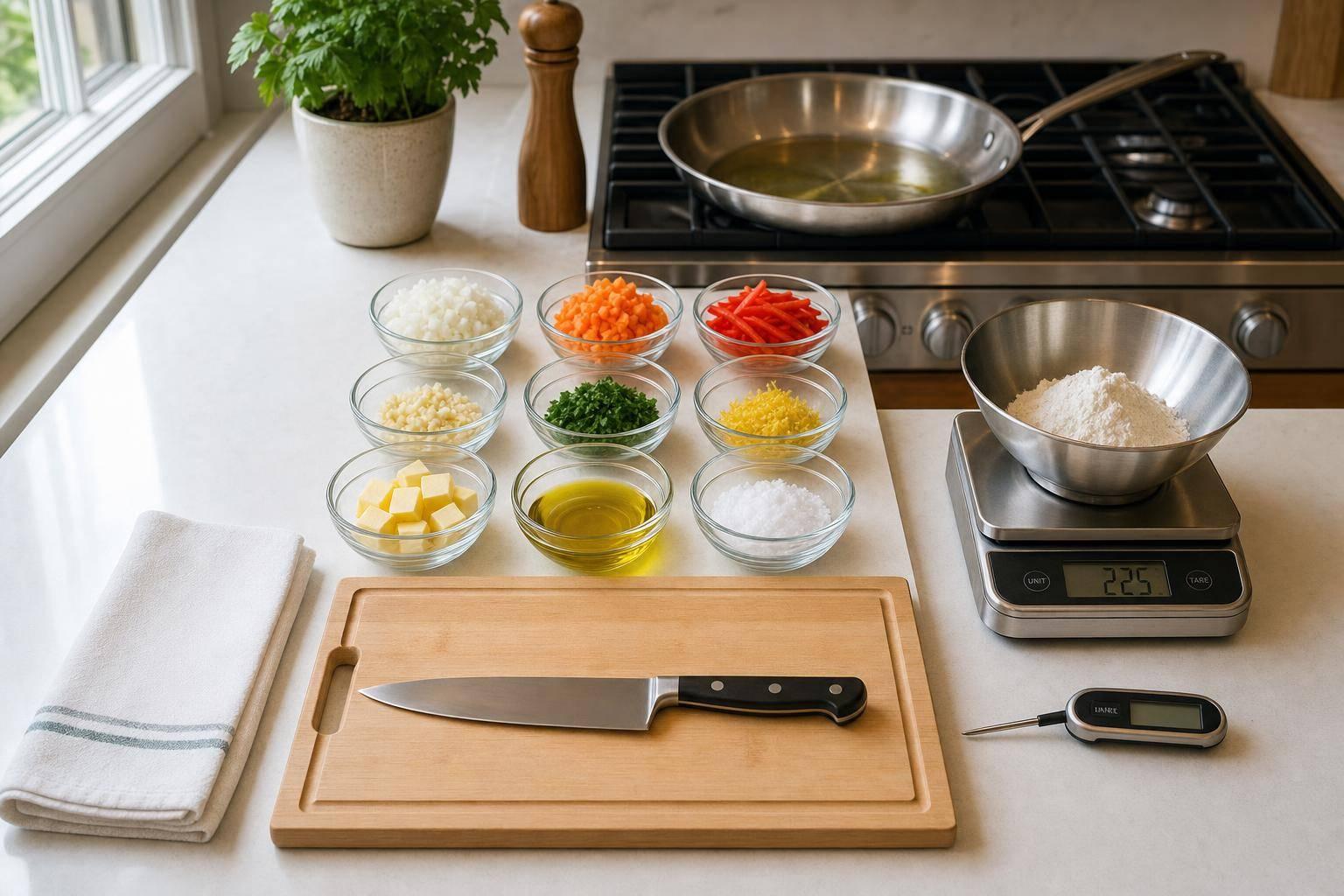
You do not need restaurant training to cook better at home. I can take a few kitchen-school habits – prep first, cut food evenly, season in layers, control heat, measure baking ingredients by weight, and follow food safety rules – and get better meals with less stress.
Here’s the short version:
- Prep before cooking: Read the recipe, set out ingredients, and cut food before heat starts.
- Use a chef’s knife well: Even pieces cook at the same rate.
- Season in steps: Salt, acid, fat, and a little sweetness can fix flat or heavy food.
- Match heat to the job: High heat for searing, lower heat for braising, and a thermometer to avoid dry meat.
- Learn one pan sauce: The browned bits in the pan can turn into flavor in minutes.
- Bake by weight: A digital scale helps with steady results.
- Keep food safe: Separate raw meat from produce, wash hands, and check temperature.
- Plan meals around shared ingredients: One prep session can cover more than one dinner.
A few facts show why these habits matter. The USDA says chicken should reach 165°F, while leftovers should be reheated to 165°F too. And in baking, even small measurement errors can change texture, which is why many bakers use a scale instead of cups.
What I like most is that these skills are not fancy. They are simple, repeatable habits that help me cook with more control at home.
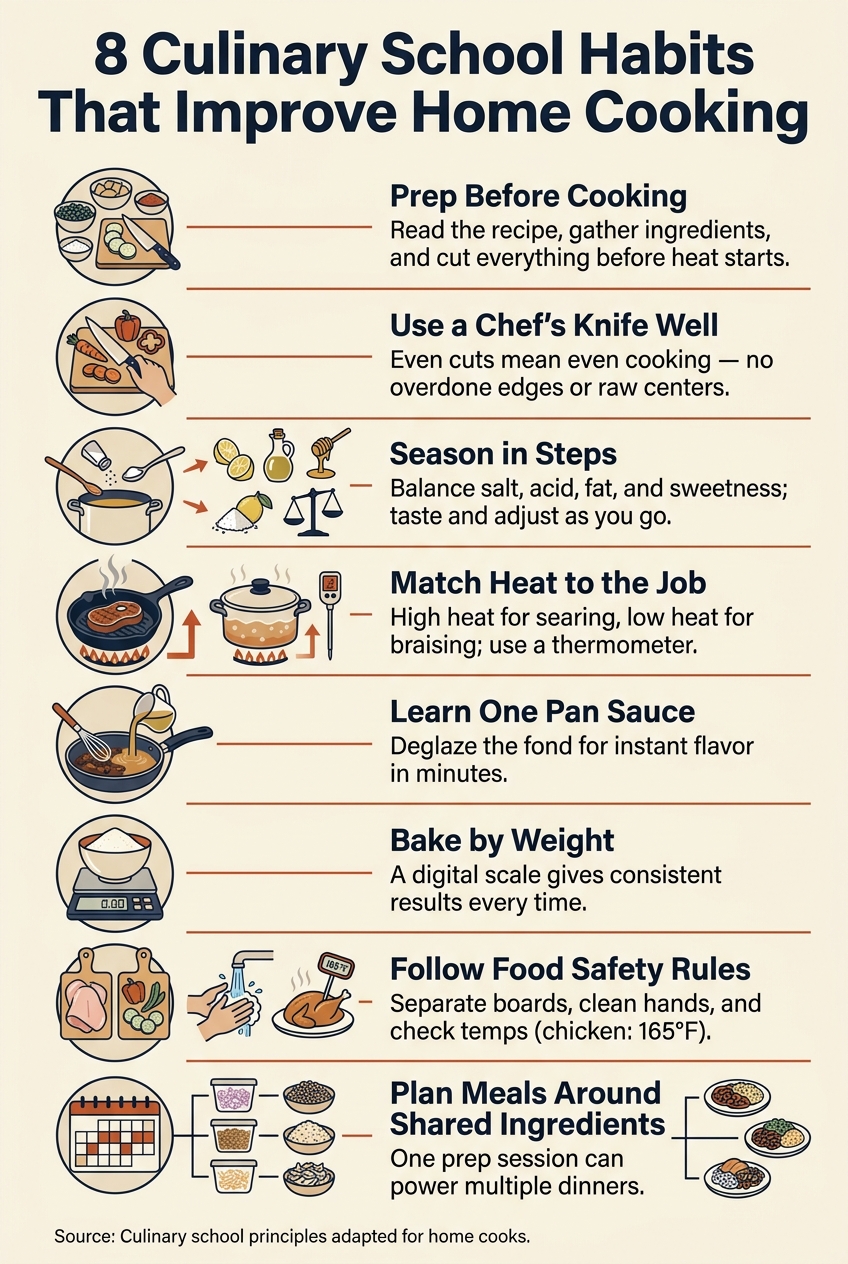
8 Culinary School Habits That Improve Home Cooking
10 Tips to Instantly Elevate Your Home Cooking
Knife Skills And Mise En Place For Faster, Safer Prep
Good prep habits make home cooking faster, calmer, and more steady. Before anything hits the pan, read the recipe, set up your workspace, and cut everything to size. It sounds simple, but it changes the whole feel of cooking. Two habits do a lot of the heavy lifting here: knife work and mise en place.
How To Use A Chef’s Knife And Cut Food Evenly
An 8- to 10-inch chef’s knife is one of the most useful tools in any kitchen. With a sharp edge and a honing steel, it can take on a big range of prep tasks.
Even cuts matter because even pieces cook at the same pace. That means no overdone edges and no underdone centers. If your onions, carrots, or potatoes are all over the map in size, your results will be too. That’s why it’s worth practicing a few core cuts like dice, slice, julienne, and chiffonade. Small habits with a knife can make a clear difference in texture and how evenly a dish cooks.
When your ingredients are cut to the same size, the next move is to get them set before the heat goes on.
How To Set Up Mise En Place Before You Cook
Mise en place is French for "everything in its place." Read the recipe, gather your ingredients, and prep everything before you start cooking. For any one-pan meal, cut ingredients to similar sizes so they finish together.
This habit cuts down stress, helps prevent mistakes, and keeps the whole meal moving without that last-minute scramble.
How To Build A Simple Home Kitchen Workflow
Once the prep is done, cook in the order that helps everything finish together. Start with the items that take the longest, then move to the faster ones. Keep what you need within reach so you’re not turning dinner into a scavenger hunt.
It also helps to clean as you go. Wash cutting boards, bowls, and prep tools during natural pauses, like when a sauce simmers or a pan preheats. By the time dinner hits the table, most of the mess is already dealt with.
Seasoning, Heat Control, And Sauce Basics That Build Better Flavor
Once your prep is in order, the next step is seasoning and heat. This is where food starts to taste more polished. At home, culinary training helps you taste, adjust, and finish dishes with more control. The big idea is simple: build flavor while you cook, not just at the end.
How To Season Food By Balancing Salt, Acid, Fat, And Sweetness
A lot of home cooks under-season because they stop too soon. The fix isn’t adding a huge amount all at once. It’s using salt, acid, fat, and sweetness together, then tasting after each small change.
Salt sharpens flavor. Acid brightens it. Fat smooths and mellows. Sweetness softens harsh edges.
You can see this in small moments at the stove. If a soup tastes flat, a pinch of salt often wakes it up. If a braised dish feels heavy, a squeeze of lemon juice can lighten it. Bit by bit, you get the dish where it needs to go. Season as you go.
How To Control Heat For Searing, Roasting, Braising, And Avoiding Overcooking
After seasoning comes heat control. This is what decides whether food browns well, gently braises, or ends up dry. Culinary training teaches you to watch the pan, trust your senses, and adjust as needed.
Use dry heat for searing and roasting. Use moist heat for braising. And use an instant-read thermometer to keep food from overcooking.
For searing, preheat the pan before the food goes in. When the oil shimmers, that’s your signal. A good sear sounds like a steady sizzle. If the sound is quiet and wet, the pan needs more heat. Those cues matter. They lead to better browning, more tender food, and fewer dry meals.
A Few Basic Sauces Worth Learning For Everyday Meals
After you sear a protein, use the fond in the pan to build flavor fast. A quick pan sauce is one of the handiest skills to learn for weeknight cooking. It starts with the fond – the browned bits left behind after searing. Don’t wash that flavor away.
"The caramelized brown bits that remain on the pan are known in France as ‘fond’ and can be used to build the flavor in a sauce." – Salt Lake Magazine [1]
Add a splash of liquid, scrape up the fond, and finish with a little butter or cream. Then spoon the sauce over chicken, fish, or vegetables for a fast finish.
sbb-itb-7261261
Baking Accuracy, Food Safety, And Meal Planning For Better Results
The same discipline that helps with savory cooking also makes baking, food safety, and meal planning a lot more steady at home.
How To Measure Accurately For Better Baking
Baking gives you less wiggle room than stovetop cooking. A bit too much flour or too little fat can change the final texture fast. That’s why culinary training puts so much weight on measuring ingredients by weight instead of scooping them by volume.
Use a digital kitchen scale. Weight stays the same, while measuring cups can shift based on how tightly you scoop. When you bake a recipe by weight and it comes out right, you can make it again and expect the same result. That level of precision matters most with doughs, custards, and breads, where careful scaling helps produce consistent results [2].
That same care also matters when you’re handling and storing ingredients.
Basic Food Safety Rules Every Home Cook Should Follow
Food safety is another place where culinary school habits help at home. A few simple moves go a long way:
- Use separate cutting boards for raw meat and produce
- Wash your hands after handling raw proteins
- Keep food at safe temperatures
- Use an instant-read thermometer to check doneness
These habits aren’t fancy, but they help you avoid cross-contamination and guesswork.
Once ingredients are handled safely and prepped well, it gets much easier to use them across more than one meal.
How To Plan Meals Around Shared Ingredients And Prep
Culinary school also teaches you to think past a single dinner. Build meals around a small set of flexible ingredients so one prep session can support more than one night of cooking. For example, roasted vegetables, cooked grains, or shredded chicken can show up in different meals without feeling like repeats.
That kind of planning cuts waste and makes weeknight cooking feel easier and less repetitive.
Conclusion: Apply Culinary School Lessons To Daily Home Cooking
These lessons carry straight into everyday cooking. They help you prep faster, build better flavor, handle food more safely, and get steadier results from one meal to the next.
The simplest way to make those habits stick is to work on one skill at a time.
Start With One Skill And Practice From There
Choose one technique and use it for a week or two. Knife skills, seasoning, or meal planning are all good places to start. Then keep repeating that same skill until it feels automatic.
FAQs
Which skill should I learn first?
Start with knife skills and mise en place. Good knife handling helps you work with less friction, makes food look better on the plate, and can cut down on kitchen waste.
Mise en place means having everything prepped and set out before you cook. Put these two basics together, and your kitchen feels more calm, more focused, and far easier to work in. They set up a strong base for almost any recipe.
What tools do I actually need?
Prioritize tools that make cooking at home more steady and exact:
- a high-quality chef’s knife for safety, speed, and less waste
- a digital thermometer for food safety and checking roasts
- a digital scale for accurate cooking and baking
Foundational cookbooks can help too. They give you a solid way to practice basic techniques. Most important, though, is having the tools you need to learn and use those core skills.
How do I practice these habits daily?
Build these habits into your cooking routine until they feel automatic.
Start with mise en place: prep and organize your ingredients before you turn on the heat. It sounds simple, but it saves time, cuts stress, and helps everything run more smoothly.
Then work on knife skills during everyday meal prep. You don’t need a big cooking project to practice. Chopping onions, slicing carrots, or dicing herbs on a weeknight gets the job done.
It also helps to use core techniques in regular dinners, not just special recipes. Make a simple sauce. Build flavor from the pan fond after searing meat or vegetables. Those small moves add up fast, and over time they start to feel like second nature.
Ready to practice these habits hands-on? Explore our cooking classes in Salt Lake City and Park City or the Professional Certificate in the Culinary Arts.
Want to learn these skills with a chef beside you? Join a hands-on cooking class in Salt Lake City or Park City, or request info about the Professional Certificate in the Culinary Arts and our online options.