
Usually, no – unless you want structure, live feedback, and plan to use the skills a lot. For most home cooks, spending $0 to $5,000 on books, short classes, and practice will make more sense than paying $15,000 to $44,000+ for a full program.
Here’s the short answer:
- If you want better weeknight meals, short classes and steady home practice are often enough.
- If you want faster skill growth, in-person correction, and stronger baking or pastry training, school can help.
- If you may start catering, cottage baking, or paid food work, a certificate can matter more.
- If your schedule is tight, a full program with 20–40 hours a week on campus may be too much.
What I take from this is simple: culinary school is less about learning recipes and more about learning technique, kitchen flow, food safety, and repetition. But home cooks do not always need the full restaurant-style curriculum, especially when parts of it cover volume prep, line speed, and inventory work.
Is Culinary School Worth The Money – Homebody Eats
Quick Comparison
| Path | Best for | Cost | Time | Main upside | Main downside |
|---|---|---|---|---|---|
| Culinary school | People who want structure, chef feedback, and deep training | $15,000–$44,000+ | 4 months to 4 years | Hands-on correction and broad skill training | High price and rigid schedule |
| Community college or short certificate | Home cooks who want guided practice without a huge bill | About $1,794+ | Shorter, part-time in many cases | Lower cost with live instruction | Less depth than full school |
| Self-study + short classes | Most home cooks | $0–$5,000 | Flexible | Low cost and focused learning | No steady live feedback |
So if you’re asking, “Will culinary school make me a better home cook?” my answer is yes, but not always enough to justify the cost. It makes the most sense when you want a set learning path, can afford it, and expect to use those skills far beyond casual cooking at home.
What Culinary School Gives Home Cooks
Core techniques that improve everyday cooking
For home cooks, culinary school can lead to better food at home: faster prep, stronger baking, and more confidence when you’re cooking for other people. The biggest payoff is repeatable technique. Instead of teaching one recipe at a time, culinary programs teach skills you can use across many dishes.
That means learning how dry-heat methods like sautéing and grilling differ from moist-heat methods like braising and poaching. Once you get that down, cooking feels less like guesswork and more like knowing which tool fits the job.
Knife skills and breaking down proteins are also central in most programs. Add prep-ahead habits and cleaning as you go, and the whole kitchen starts to run better, especially when guests are coming over [1].
"Nailing the fundamentals of dry heat… and moist heat… cooking gave me a confident foundation… It gave me the base needed to never feel like I’m truly ‘flying blind’ in the kitchen… even when making a recipe I’ve never cooked before." – Maddy DeVita, Private Chef and Culinary Graduate [1]
Those basics become even more important once you move from day-to-day cooking into baking and pastry.
Baking, food science, and plating skills that raise quality
Baking is one area where structured training can pay off fast. Classes cover how doughs, custards, emulsions, and heat reactions shape texture and flavor. That makes it easier to fix problems when something goes wrong instead of making the same recipe again and hoping for a better result [7] [8].
Pastry and baking tracks often include breads, chocolates, and cake decoration. Those are skills many home cooks struggle to learn through trial and error alone. Sometimes a small shift in technique can change flavor, texture, and consistency in a big way. Plating can also make home-cooked meals look more polished [7].
The next piece is structure: does the school help you spot mistakes sooner?
Food safety and hands-on feedback you may not get at home
Self-study has one big gap: you don’t know what you’re missing. A video can show knife technique, but it can’t point out that your grip is slightly off. Culinary programs deal with that through direct instructor feedback in real time [1].
Food safety is another area where formal training matters. Programs cover sanitation, cross-contamination prevention, and proper cooking and storage temperatures [2].
Park City Culinary Institute offers chef-led Culinary Arts, Cuisine, and Pastry & Baking programs with hands-on instruction in doughs, custards, butchery, knife work, and seasoning [6] [7]. That kind of in-the-moment feedback is one of the clearest upsides of formal training.
The next question is whether those gains are worth the tuition, time, and schedule.
sbb-itb-7261261
What Culinary School Costs and Where It May Not Be Worth It
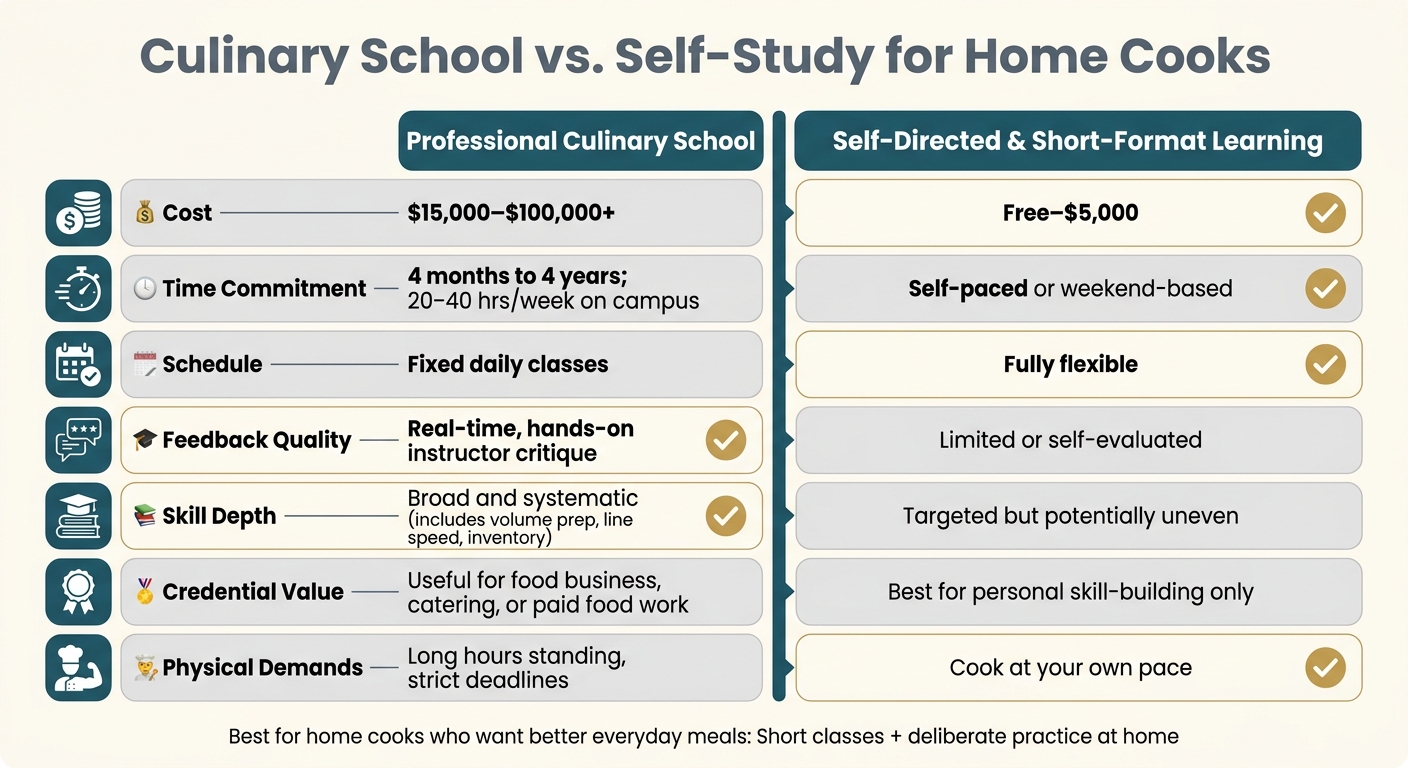
Culinary School vs. Self-Study: Cost, Time & Value for Home Cooks
Tuition, schedule, and opportunity cost
Culinary school can cost a few thousand dollars or more than $44,000, depending on the format and program length. For home cooks, that leads to a simple question: Will you use the skills enough to justify the price? Park City Culinary Institute, for example, lists programs from $1,495 to $9,990 on campus, with lower online pricing for some options.
Tuition isn’t the whole bill, either. You may need to set aside another $500–$1,500 for a knife kit, chef coats, shoes, and textbooks [3][5]. In some cases, that same amount could go toward gear for your own kitchen, ingredients for practice, or a few short workshops.
Then there’s the time commitment. Many on-campus programs ask for 20–40 hours a week of in-person attendance, plus commuting [3][1]. If you already work full-time or you’re juggling family life, that kind of schedule can be hard to fit in. And for some people, that time cost hits just as hard as the tuition bill.
Parts of a professional curriculum a home cook may not need
Professional culinary programs are built for restaurant work, not weeknight dinners at home. So part of the curriculum often covers large-scale production, line speed drills, and inventory management. Those are useful in a commercial kitchen, but most home cooks won’t touch them in daily life [9][4].
Of course, that changes if you’re thinking ahead. If you might start a small catering side business or work as a personal chef, those topics start to make more sense [9][1]. It comes down to fit. Are you paying for training you’ll use often, or sitting through sections that don’t match how you cook?
Lifestyle and learning-style tradeoffs
On-campus training comes with structure. You show up at set times, stand for 4–10 hours at a stretch, and get graded while working under pressure. Some people like that setup because it keeps them on track. Others hit a wall fast [4][1].
It can also run headfirst into normal life. Full-time jobs, kids, errands, and traffic don’t disappear just because class starts at 8:00 a.m.
Here’s how the tradeoff looks side by side:
| Factor | Culinary School | Learning at Home |
|---|---|---|
| Cost | Can range from a few thousand dollars to $44,000+ | Low – ingredients, books, basic tools |
| Feedback | Real-time from an instructor | Self-assessed or delayed |
| Curriculum | Broad, includes volume and management | Targeted to what you actually cook |
| Schedule | Fixed, 20–40 hrs/week on campus | Fully flexible, self-paced |
| Physical demands | Long hours standing, strict deadlines | Cook when you want, at your own pace |
The next section looks at lower-cost ways to build many of the same skills without locking yourself into a full program.
Lower-Cost Ways to Build Similar Skills
Cookbooks, videos, and deliberate practice
If full culinary school feels too expensive or too rigid, you still have other ways to build solid kitchen skills. Cookbooks, videos, and well-known cooking websites are often free or low cost, and they give you a lot of flexibility. You can practice on your own schedule and work through core techniques like knife skills, sautéing, braising, and steaming at your own pace. [1]
That said, self-study has a weak spot: no live correction. When no one is there to point things out, home cooks often repeat the same mistakes, miss key basics, and spend time learning from weak instruction. [1]
Short classes and targeted skill building
If you want more structure without signing up for a full program, short classes can be a good middle option. Community college certificates, short cooking classes, and focused workshops give you hands-on practice and direct feedback in less time than a full culinary program. Many also teach the tools and kitchen workflow that home cooks use most often. [2]
Online culinary programs can sit in that middle ground too. Some combine on-demand video lessons with one-on-one chef coaching and personal feedback, which gives you more support than learning alone. [7]
Tools that improve results when used correctly
Good tools can make practice smoother, but they don’t do the work for you. Technique still comes first. Still, when your skills are solid, a sharp chef’s knife, an instant-read thermometer, and a stand mixer can help you get better results. [1]
Lower-cost paths can help you build real skill in weeknight cooking, baking, and food safety. The tradeoff is that they usually don’t offer the same depth or structured feedback as formal training. The better choice comes down to how much direction you want and how fast you want to get better.
How to Decide if Culinary School Is Worth It for You
The best way to decide is to look at your budget, your schedule, and your goal. If you mainly want to cook better at home, the key question is simple: is the extra structure worth the price?
| Feature | Professional Culinary School Program | Self-Directed & Short-Format Learning |
|---|---|---|
| Cost | $15,000–$100,000+ [5] | Free–$5,000 [5] |
| Time Commitment | 4 months to 4 years; often daily classes [3] | Self-paced or weekend-based [3] |
| Feedback | Immediate, hands-on instructor critique | Limited or self-evaluated |
| Skill Depth | Broad and systematic | Targeted but potentially uneven |
| Credential Value | Useful only if you want a formal credential for future food work | Best for personal skill-building, not a credential |
When formal culinary training makes sense
Formal training tends to make sense when you need structure and have a reason to go deeper than weeknight cooking. If you have the money, the time, and goals that stretch past better everyday meals, it may be worth a close look.
That can include home cooks who want to build stronger technique faster, people thinking about catering or cottage baking, and anyone who knows self-study sounds good in theory but falls apart in practice. Some people learn well on their own. Others do far better when someone is there to correct knife work, fix timing, and point out what they’re missing.
"Culinary school will very likely help expedite the process of getting you there, largely through all of the intangible benefits. It gives you the stamp of authority that comes with saying you’re a professionally-trained chef." – Maddy DeVita, Private Chef and ICE Alumna [1]
That formal credential can also help if you later want to start a food business or take paid food work. It doesn’t matter much for making dinner at home, but it can matter when money and client trust enter the picture.
When flexible alternatives are the better fit
If you want better family meals, more confidence when people come over, or stronger baking results, a full culinary program is often more than you need. In that case, shorter and more flexible options usually make more sense.
This path fits best when your budget is tight, your calendar is packed, or you want to improve one area at a time instead of studying across the board. Maybe you want to fix your bread, learn sauces, or stop overcooking fish. You don’t always need a full program to do that.
Where Park City Culinary Institute fits on that spectrum
Park City Culinary Institute sits somewhere in the middle. It offers certificate programs and recreational classes, so home cooks can choose between shorter skill-building and a more structured training path.
Its ACF-approved, nationally recognized certificates can also add professional credibility if you ever want to start a food business or take paid food work.
FAQs
How do I know if culinary school is worth it for me?
It depends on your goals, budget, and how you like to learn.
If you’re after personal enrichment, it helps to weigh the structure of a formal program against the freedom of self-directed learning through cookbooks, workshops, and lots of practice.
Culinary school may be worth it if you want hands-on training, direct feedback from pros, and a clear path from one skill to the next. If your goals are more recreational, lower-cost workshops may be enough.
What skills are hardest to learn without live instruction?
The hardest skills to pick up without live, supervised instruction are the ones that demand precision, physical control, and steady heat management.
That includes knife skills, butchery, and the small but important differences between dry-heat and moist-heat cooking methods. These aren’t just ideas you read about and instantly get. They depend on timing, hand position, pressure, and feel.
Live instruction matters for another reason too: feedback in the moment. A teacher can correct your grip, adjust your posture, and stop bad habits before they stick. That kind of guidance also helps teach the discipline, cleanliness, and respect for the kitchen that lead to steady results.
Can short classes give me enough structure to improve quickly?
Yes. Short classes and certificate programs give home cooks a clear, structured way to build core kitchen skills.
That can include things like knife skills, butchery, and key cooking methods. Instead of piecing it all together on your own, you learn in a setting built for practice, correction, and repetition.
The big advantage is direct feedback. A good instructor can spot small mistakes early, help you fix them, and steer you toward better habits before those habits get locked in. That often helps people build confidence faster than they would through trial and error alone.
And for many people, that’s the sweet spot: skill-building without the time and cost of a multi-year degree.
Ready to build real kitchen skills for your own table? Try a hands-on cooking class in Salt Lake City or Park City, or request info about our Cuisine and Pastry & Baking certificates.
Related Blog Posts
- Culinary School vs Self-Taught: Which Path Works?
- Online vs In-Person Culinary Training Compared
- Why Home Cooks of All Ages Are Coming to Our Culinary School – From Age 11 to 80
- Can You Go to Culinary School While Working Full Time?
If you’re ready for structured training, see the Professional Certificate in the Culinary Arts or our cooking classes for serious home cooks.