



Yes – freeze-drying usually keeps more vitamins than heat-based drying. From what I see in the article, the main reason is simple: low heat and less oxygen exposure help protect vitamins that break down fast, like vitamin C, B1, and folate.
If I had to sum it up in a few lines, it would be this:
- Freeze-drying can retain up to 97% of original nutrients
- It often beats hot-air drying and can outperform spray drying for heat-sensitive vitamins
- The biggest weak point is storage, not just processing
- Oxygen, light, moisture, and temperature drive vitamin loss after drying
- The biggest drops often show up around 6 to 12 months
In plain terms, freeze-drying gives you a strong starting point. But packaging and shelf life decide how much nutrition is still there when someone finally uses the product.
What matters most:
- Vitamin C: one of the first vitamins to break down with heat
- B vitamins: often hold up better with freeze-drying than with hotter methods
- Fat-soluble vitamins like A, E, and K: usually stay more stable during drying, but can still break down during storage
- Water removal of 80% to 95%: makes nutrients more concentrated per gram
| Area | Main takeaway |
|---|---|
| Processing | Freeze-drying protects vitamins by avoiding high heat |
| Best-fit vitamins | Vitamin C, B1, folate, and other heat-sensitive nutrients |
| Main risk after drying | Oxygen, moisture, light, and warm storage |
| Best handling steps | Airtight packaging, low oxygen, and fast packing after drying |
So if you want the short answer: freeze-drying is one of the better ways to keep vitamin content high, but storage controls the final result.
Does Freeze Drying Really Preserve Nutrients?
sbb-itb-7261261
What Research Shows About Vitamin Retention
Research tends to point in the same direction: freeze-drying keeps more vitamins than most other drying methods. USDA data shows that freeze-dried foods can retain up to 97% [2] of their original nutrients. A big reason is simple. Freeze-drying avoids the kind of heat that can wear down vitamins in hotter drying methods.
Vitamin C and Other Heat-Sensitive Vitamins
Vitamin C is one of the easiest nutrients to lose during food processing. In broccoli, research shows that vitamin C breaks down faster as temperature goes up [4].
B vitamins follow a similar pattern. Studies on freeze-dried Agaricus blazei Murrill mushrooms found vitamin B1 at 1,151 μg per 100 g of dry matter, B9 (folate) at 671 μg per 100 g, and B12 at 906 μg per 100 g [6]. That’s a big deal for supplement ingredients, where steady vitamin levels are often the whole point of using this process.
Fat-Soluble Vitamins and Overall Nutrient Retention
Fat-soluble vitamins, such as vitamin A precursors (carotenoids), vitamin E, and vitamin K, are mostly kept during freeze-drying because the process limits heat exposure and oxidation. In mushroom studies, ergosterol, a vitamin D2 precursor, also stayed at a substantial level after freeze-drying [6].
Freeze-drying removes about 80% to 95% of water weight, which means nutrient levels per gram go up even when total retention differs by compound. In plain terms, the food gets lighter while many nutrients stay put. Retention is strongest when oxygen and moisture remain low after drying.
The next question is how well those gains hold during storage.
Freeze-Drying vs. Other Drying Methods
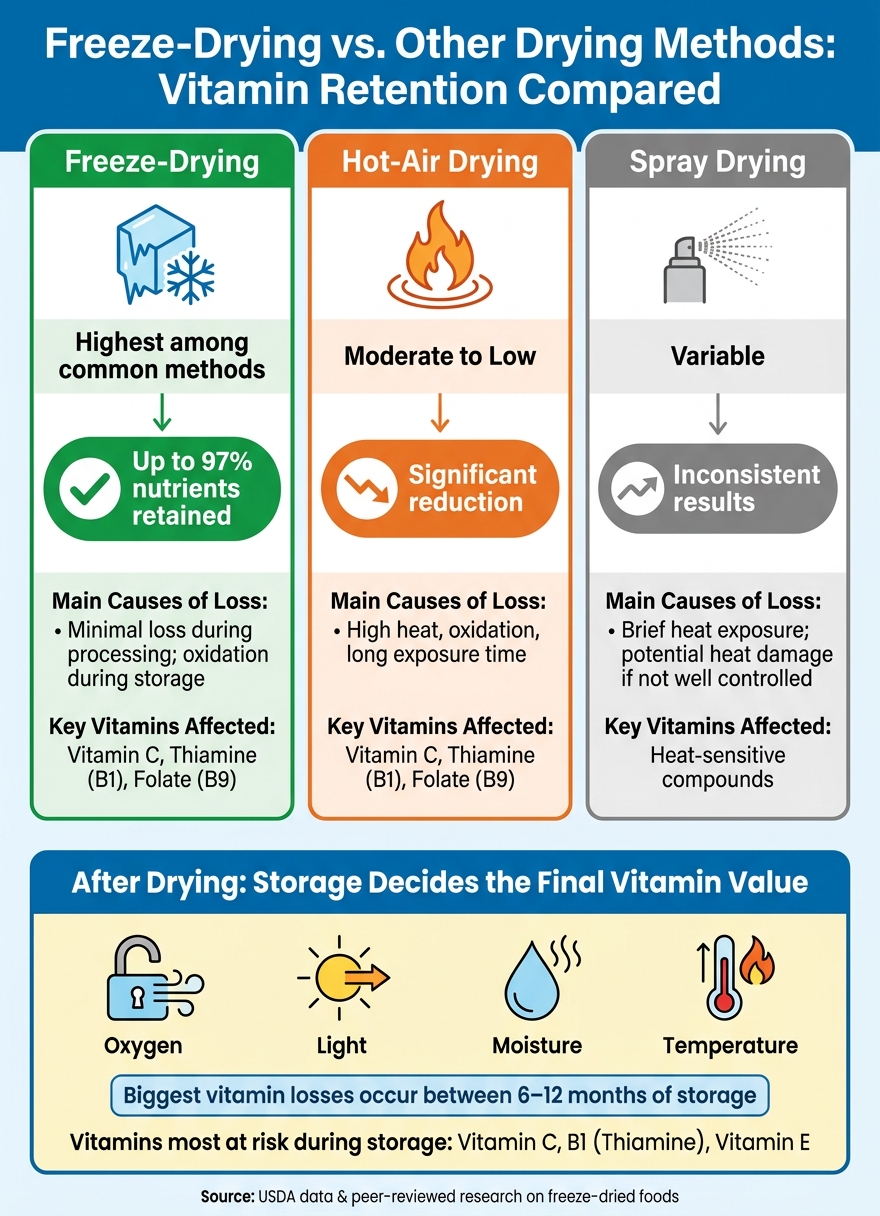
Freeze-Drying vs. Other Drying Methods: Vitamin Retention Compared
Not all drying methods protect vitamins the same way. Researchers look at vitamin levels before and after drying to measure nutrient loss. And when freeze-drying is stacked up against heat-based methods, the gap is usually pretty clear.
Why Freeze-Drying Tends to Preserve More Vitamins
Freeze-drying uses little heat and exposes food to less oxygen. That matters because vitamins like C, thiamine, and folate break down more easily under harsh processing conditions. Heat-based methods remove moisture by applying heat, and that creates the exact conditions that can damage those nutrients.
That’s why freeze-drying often holds onto more vitamins than other drying methods: it cuts down on both heat damage and oxygen exposure [5].
Where the Biggest Differences Appear
The biggest gap tends to show up with vitamin C and B vitamins, since they’re more likely to break down when heat is involved.
Here’s how common drying methods compare for vitamin retention:
| Drying Method | Typical Vitamin Retention | Main Causes of Nutrient Loss | Key Vitamins Affected |
|---|---|---|---|
| Freeze-Drying | Highest among common methods | Minimal loss during processing; oxidation during storage | Vitamin C, thiamine, folate |
| Hot-Air Drying | Moderate to low | High heat, oxidation, long exposure time | Vitamin C, thiamine, folate |
| Spray Drying | Variable | Brief heat exposure; potential heat damage if not well controlled | Heat-sensitive compounds |
After drying, storage conditions decide how much of that edge freeze-drying keeps.
How Vitamins Hold Up During Storage After Freeze-Drying
After drying, storage conditions decide how much vitamin value stays in the food. Freeze-drying helps protect vitamins at the start, but storage can still chip away at them over time.
Key Factors That Affect Vitamins During Storage
Once a food has been freeze-dried, four things do most of the damage: oxygen, light, moisture, and temperature. Vitamins A, C, and E are hit the hardest by oxidation, which is why airtight packaging matters so much [1][3].
Moisture control also plays a big part. Even a small bump in water activity can speed up vitamin breakdown. Temperature has a big effect too. For example, vitamin C breaks down much more slowly at 41°F than at 248°F [4].
If a product is stored without refrigeration, high-barrier, airtight packaging and nitrogen flushing are two of the best ways to cut oxygen-driven losses [5].
This matters most over months, not just a few days.
What Long-Term Studies Show About Shelf Stability
Most long-term storage studies show that the sharpest vitamin losses happen between 6 and 12 months [6]. Vitamin B1 (thiamine), vitamin C (L-ascorbic acid), and vitamin E (α-tocopherol) usually drop the most during that stretch [6].
Here are the storage variables that have the biggest effect:
| Nutrient | Critical Storage Window | Main Risk Factors |
|---|---|---|
| Vitamin C | 6–12 months; losses accelerate [6] | Temperature, oxygen, light [1][3][4] |
| B Vitamins (B1, Folate) | Greatest losses at 6–12 months [6] | Heat, moisture, oxygen, light [1] |
| Vitamins A, E, and K | Gradual oxidative loss over time [1] | Light and oxygen exposure [1] |
Practical Takeaways for Supplement, Food, and Culinary Use
Using Freeze-Dried Ingredients Without Overstating Nutrition Claims
Once drying is done, what happens next has a big effect on how much vitamin value stays in the product. Freeze-dried fruits, vegetables, and supplement ingredients can help support nutrient-dense products when they’re handled with care. Since removing water concentrates vitamins per gram, freeze-dried products often provide more per serving than their fresh counterparts [1].
For product developers and supplement formulators, the key is to be precise. Name only the vitamins your process and packaging keep in place instead of leaning on broad claims like “nutrient-rich,” which storage conditions can quietly weaken over time.
These steps matter most when products need to stay stable during storage and distribution:
- Blanch vegetables before drying to deactivate enzymes that drive nutrient loss during storage [1][5]. Some water-soluble vitamins can leach into the blanching water, so there’s a tradeoff.
- Package immediately in airtight, low-oxygen packaging after the freeze-drying cycle ends [5].
- For highly sensitive compounds, encapsulation with alginate or pectin can slow oxidation [7].
For culinary use, freeze-dried powders are especially handy because they add nutrients without adding moisture. That makes them a good fit for both supplement manufacturing and menu development.
Conclusion: What the Evidence Supports
Put together, these practices help protect the vitamin gains that freeze-drying can deliver. The research points in the same direction: freeze-drying generally preserves vitamins better than higher-heat drying methods, especially for heat-sensitive nutrients like vitamin C, thiamine (B1), and folate (B9) [1][5]. Even so, retention still depends on the vitamin itself, the ingredient, any pre-treatment steps, and how the product is stored after drying.
The takeaway is simple: freeze-drying gives you a strong nutritional starting point, but packaging, storage conditions, and shelf life decide how much of that value reaches the end user.
FAQs
Does freeze-drying destroy vitamins?
Not usually. Freeze-drying tends to do a good job of preserving heat-sensitive vitamins because it removes water at low temperatures under vacuum, instead of using the high heat common in standard dehydration.
It can retain up to 97% of the original nutrients, although a small amount of nutrient loss can still happen. Storing freeze-dried foods in cool, dark, airtight containers helps reduce more vitamin loss over time.
Which vitamins benefit most from freeze-drying?
Freeze-drying works especially well for vitamins that don’t handle heat or oxygen very well, especially vitamin C and some B vitamins like thiamine and folate.
Because the process uses low temperatures and a vacuum, it helps prevent the nutrient loss that often happens with high-heat drying. Vitamins A, E, and K hold up better to begin with, and they also stay well preserved.
How should freeze-dried products be stored?
Store freeze-dried products in sealed, airtight containers to help keep their nutrients in place.
For the best results, keep them in a cool, dark place. Light, heat, and oxygen can break down sensitive vitamins like A, C, and E. Good storage also helps maintain quality, color, and flavor.
Curious about the science behind great food? Our chefs teach how heat, time, and technique change flavor and texture. Learn with us online from your own kitchen, join a hands-on cooking class in Salt Lake City, or request info and call (801) 413-2800.