
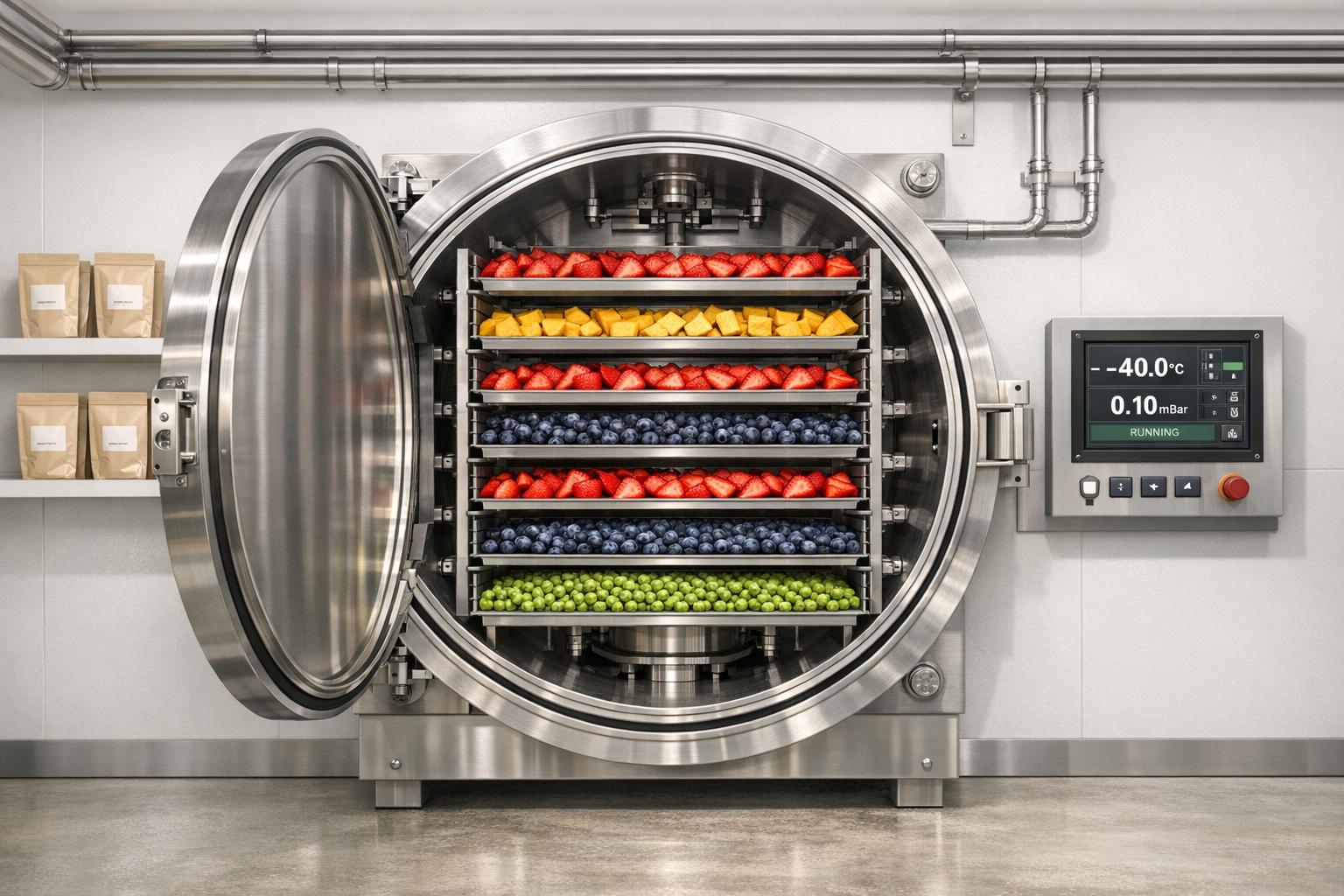
Freeze-drying is a moisture removal process that preserves food by turning ice into vapor through sublimation. Understanding food science helps explain how it retains up to 97% of nutrients, extends shelf life to 10–25 years, and reduces water weight by 98%, making products lightweight and cost-effective for shipping. This method is ideal for food startups targeting markets like e-commerce, outdoor enthusiasts, or emergency supplies.
Key Points:
- Nutrient Retention: Maintains up to 97% of vitamins and nearly all minerals.
- Shelf Life: Products last 10–25 years in airtight packaging.
- Lightweight: Reduces weight by 70%–90%, cutting shipping costs.
- Equipment Costs: Ranges from $2,000 to $200,000, depending on scale.
- Regulations: FDA and USDA compliance is essential for safety and legality.
Freeze-drying offers startups a way to create long-lasting, high-quality products while minimizing food waste and expanding into new markets. The process requires careful planning, proper equipment, and adherence to safety standards.
Benefits of Industrial Freeze-Drying for Food Startups
Longer Shelf Life and Better Product Quality
Freeze-drying works by removing 96%–99% of moisture through a process that turns ice directly into vapor under vacuum conditions. This method keeps the food’s shape and cellular structure intact, allowing for quick rehydration when needed [5]. By reducing water activity to 0.3 or below, it effectively halts microbial growth [3]. When paired with moisture-proof packaging, like 5–7 mil Mylar bags with oxygen absorbers, freeze-dried products can stay shelf-stable for over 25 years without refrigeration [6][8]. This eliminates the need for costly cold-chain logistics. Plus, the preserved quality gives startups a chance to reach markets that were previously out of reach.
Access to New Markets
Freeze-drying doesn’t just enhance quality – it also opens up a world of market opportunities. These products are 70%–90% lighter than their fresh counterparts, making them ideal for outdoor enthusiasts, backpackers, and emergency preparedness customers [8]. Additionally, startups can cater to health-conscious consumers by offering clean-label products that retain nutrients without relying on chemical additives [4][7]. As Peter Zichy, Area Sales Manager for Freeze Drying at GEA, highlights:
"One of the biggest advantages of freeze-dried food is that it requires no refrigeration, drastically cutting energy use during transport and storage" [8].
This advantage makes it easier to enter international markets, particularly in regions where refrigeration infrastructure is limited.
Less Food Waste
Freeze-drying also plays a key role in reducing food waste. By extending shelf life, it allows surplus produce to be transformed into valuable products, increasing profitability. For instance, fruits and vegetables that don’t meet cosmetic standards can be turned into powders, snack bars, or granola ingredients. Similarly, meat trimmings and organ cuts can be repurposed into high-protein pet treats, which are rapidly growing in popularity in the freeze-dried product sector [10][11]. Peter Zichy underscores this point:
"Food waste isn’t just a loss – it’s an opportunity. With freeze-drying technology, we can take surplus fruits, vegetables and other perishables and transform them into high-value, long-lasting products" [8].
Preserving seasonal harvests for year-round availability further minimizes unsold stock, helping startups stabilize their revenue streams.
sbb-itb-7261261
This is How You SCALE Your Freeze Drying Business
Industrial Freeze-Drying Equipment: Types and Costs
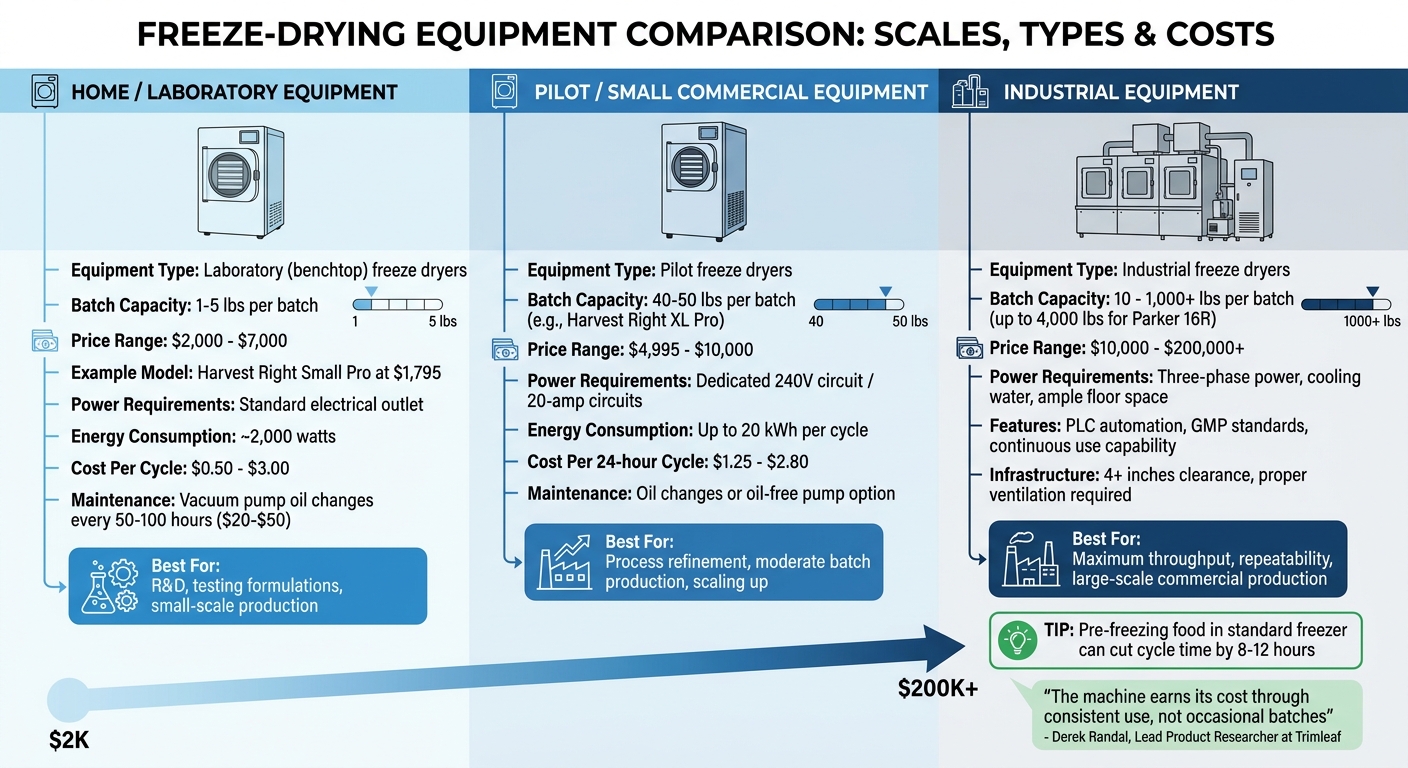
Home vs Commercial vs Industrial Freeze-Drying Equipment Comparison
Types of Freeze-Drying Equipment
Choosing the right freeze-drying equipment is crucial for scaling production effectively. There are three main types of freeze dryers, each catering to different stages of business growth.
Laboratory (benchtop) freeze dryers are compact units designed for small-scale use, typically handling just a few liters per batch. These are perfect for research and development or testing initial formulations [12]. Moving up in scale, pilot freeze dryers are used to refine drying cycles and process moderately sized batches before transitioning to full-scale production [12].
At the highest level, industrial freeze dryers are built for large-scale operations. These machines are designed for continuous use, with ice-condensing capacities that can handle hundreds of liters per cycle. They feature advanced automation systems, such as Programmable Logic Controllers (PLCs), and meet Good Manufacturing Practices (GMP) standards [12]. While smaller home units manage 1–5 lbs per batch, industrial models can process anywhere from 10 to over 1,000 lbs in a single cycle [13]. As Kintek Solution explains:
"Industrial freeze dryers are engineered for maximum throughput, repeatability, and automation, whereas laboratory and pilot models are designed for flexibility, data collection, and process refinement" [12].
Understanding these categories is a critical first step before diving into the costs and budget considerations.
Equipment Costs and Budget Planning
The cost of freeze-drying equipment spans a wide range depending on the size and capacity of the machine. For home use, units typically cost between $2,000 and $7,000. Smaller professional models, such as the Harvest Right Small Pro, start at $1,795 [13][14]. Startups looking to scale up might consider the Harvest Right XL Pro, which can process 40–50 lbs per batch and costs around $4,995. This model also requires a dedicated 240V circuit [14].
Industrial freeze dryers represent a much larger investment, with prices ranging from $10,000 to over $200,000 based on capacity and features [13]. These machines also come with notable operational costs. For instance, industrial units can consume over 2,000 watts and use up to 20 kilowatt-hours per cycle [15]. Depending on electricity rates, running a 24-hour cycle typically costs between $1.25 and $2.80, with per-cycle costs ranging from $0.50 to $3.00 [15].
Maintenance is another expense to consider. Vacuum pump oil changes are required every 50–100 hours of use and cost $20–$50 per replacement [13]. If you’re running frequent batches – two or more per week – an oil-free pump could save on recurring maintenance costs and pay for itself within a year [14]. Derek Randal, Lead Product Researcher at Trimleaf, emphasizes:
"The machine earns its cost through consistent use, not occasional batches" [14].
Infrastructure needs can also impact your budget. Industrial units often require high-capacity electrical service, such as three-phase power, along with cooling water and ample floor space. Proper ventilation is critical, with at least 4 inches of clearance recommended [12][13]. Even smaller commercial units need dedicated 20-amp circuits to handle their power demands [15]. To save on energy costs, pre-freezing food in a standard freezer before loading the freeze dryer can cut cycle time by 8 to 12 hours [14].
Regulations and Permits for Freeze-Drying Businesses
Food Safety Standards and Compliance
When starting a freeze-drying business, understanding which federal agency oversees your products is crucial. The FDA regulates most foods in interstate commerce, while the USDA handles meat, poultry, and certain processed egg products [16]. Each agency has unique requirements for registration and inspections, so knowing where your product fits is essential.
If your business involves food for U.S. consumption, you must register your facility with the FDA. This applies to facilities that manufacture, process, pack, or hold food for the U.S. market. Registration requires a DUNS number, which you can obtain through Dun & Bradstreet [16]. Once registered, your business must comply with the Food Safety Modernization Act (FSMA). This means evaluating potential hazards, implementing preventive controls, and keeping detailed monitoring records [16]. Additionally, you’ll need to follow Current Good Manufacturing Practices (cGMP) outlined in 21 CFR Part 117. These standards ensure food is produced under safe and sanitary conditions [16].
Freeze-dried foods must meet specific water activity levels (Aw ≤ 0.85) to be considered safe, with an optimal range of 0.08 to 0.33 [3][17]. Since freeze-drying preserves bacteria rather than eliminating them, you’ll need to include a validated kill step for high-risk ingredients. Utah State University Extension food safety experts warn:
"Freeze-drying does not kill bacteria and/or other microbes. It preserves them" [3].
For example, cook meats to 160°F, poultry to 165°F, and seafood to 145°F before freeze-drying [3]. For raw eggs, use pasteurized liquid eggs or fully cooked scrambled eggs to minimize risk [3]. Labels must be accurate, in English, and include nutrition details and allergen information as required by 21 CFR 101 [16]. You’ll also need to maintain "one up, one down" records to track both the source of your ingredients and the recipients of your finished products [16].
Beyond food safety, obtaining the correct licenses and permits is vital to operate legally.
Required Licenses and Permits
Navigating licensing requirements is a key step for businesses moving from small-scale operations to larger production. Many startups begin under Cottage Food Laws, which allow limited home-based production of low-risk foods like freeze-dried fruits or candies. However, these laws often exclude items like meats, vegetables, or dairy [18][19]. If your products fall outside these allowances or you plan to sell wholesale or across state lines, you’ll need a Commercial Food Processing License. Additional requirements include a city or county business license, Sales Tax Permit, and an EIN or DBA registration [18].
For freeze-dried foods packaged in Mylar bags with oxygen absorbers, some states may require Reduced Oxygen Packaging (ROP) approval or a HACCP plan to address botulism risks [18]. You might also need lab tests to confirm your products meet shelf-stability standards. Private labs typically charge $50 to $150 for water activity and pH testing [18]. To avoid surprises, consult with local health inspectors early to confirm whether your products qualify under home-based permits and what testing they require [18].
| Requirement Type | Home-Based (Cottage Food) | Commercial / Industrial |
|---|---|---|
| FDA Registration | Generally Exempt [16] | Required [16] |
| Facility Type | Private Residence | Certified Commercial Kitchen [18] |
| Allowed Products | Mostly fruits, candies, herbs [18][19] | All (including meats/dairy) [18] |
| Sales Channels | Often limited to in-person or in-state [18] | Wholesale and Interstate allowed [16] |
| Inspections | Rare (usually complaint-based) | Regular/Scheduled [16] |
How to Start a Freeze-Drying Food Business
Research and Product Development
Picking the right niche is a key step in launching a freeze-drying food business. With the global freeze-dried food market expected to hit $86.7 billion by 2025, focusing on specific segments like emergency supplies, lightweight camping meals, healthy snacks, pet treats, or specialty ingredients for chefs can set you apart [20]. Choose a niche that fits both market trends and what you can realistically handle. Once you’ve settled on your focus, dig into the details – study your target audience, analyze competitor pricing, understand regulations, and craft a solid business plan that covers finances, marketing, and operations.
Product development is just as important. Experiment with recipes, gather feedback from taste panels, and test for shelf stability by checking things like pH and water activity levels [20]. Before you start producing for sale, run a "bread run" (a test cycle with sliced bread) to clear out any odors from new equipment and confirm that sensors are working properly [21]. Keep in mind that some items, like high-fat foods (e.g., butter or fatty meats) and pure sugars (like honey), don’t freeze-dry well – they can spoil or fail to solidify [21]. Once you’ve nailed down your product, move on to sourcing equipment and setting up your workspace.
Getting Equipment and Finding Facilities
Your equipment needs to match your production goals. Many new businesses start small, using commercial units like the Parker Summit, which can handle 97 lbs of wet weight per cycle, and then scale up to industrial machines like the Parker 16R, capable of processing up to 4,000 lbs per batch [22]. Manufacturers often provide calculators to help estimate the right machine size for your needs. Be prepared for startup costs ranging from $39,500 to over $145,000 [20].
Your facility setup is just as crucial. Maintain a workspace with good ventilation and temperatures between 45°F and 80°F [1]. If you’re planning to sell items like meats or dairy, you’ll need a certified commercial kitchen and the necessary licenses [18]. Regular maintenance is non-negotiable – clean your equipment, lubricate moving parts, and, for oil-based models, change the vacuum pump oil routinely [11]. Once your setup is ready, you can shift focus to branding and reaching your audience.
Marketing and Distribution
Creating a strong brand starts with choosing a memorable name and maintaining consistent messaging across all platforms. To market your business, consider a mix of strategies: build an e-commerce site, engage on social media, create content like blogs or videos, send email newsletters, and attend farmers’ markets or trade fairs. A marketing budget of $2,000 to $10,000 is typical for a new freeze-drying business [20].
"Start with a focused product line and expand as you perfect your offerings" [20].
Proper packaging is also key. Use 5–7 mil Mylar bags without clear windows, paired with oxygen absorbers, to protect your products from air and moisture and extend their shelf life [1]. Explore partnerships with retailers that focus on health or outdoor products, and keep your customers engaged with seasonal or limited-edition items. With careful planning, freeze-drying businesses can achieve profit margins of 30% to 50% or more [20].
Common Challenges and Quality Control
Common Freeze-Drying Challenges
Running an industrial freeze-drying operation comes with its fair share of technical difficulties, many of which can directly influence production efficiency and costs. One of the biggest concerns is energy consumption. Traditional freeze-drying processes can use up to 15 kWh per cycle, and long drying times can drive up utility expenses if not carefully managed[9].
Another frequent issue is structural collapse. If the product’s temperature exceeds its collapse point during the primary drying stage, the porous structure of the food can break down. This results in a denser product that doesn’t rehydrate well[9]. To avoid this, it’s critical to keep the shelf temperature about 4–5°F below the collapse temperature throughout the process.
Case-hardening is another challenge. This happens when the outer layers of the product dry too quickly, trapping moisture inside. This can lead to uneven drying or even spoilage. To counter this, cutting food into evenly sized pieces – ideally no thicker than 1/2 inch – can help ensure uniform drying[1]. However, these challenges can differ depending on the specific ingredients being processed.
For example, in March 2024, Anannya, the founder of Toronto-based Farm Fetch Pets, shared that her team had to reformulate their pet food recipes five times to get the fat content just right[24]. This highlights ingredient-specific challenges: high-fat foods are more resistant to freezing and can spoil faster, while high-sugar foods tend to retain moisture, extending drying times and increasing energy use[1].
Another critical safety consideration is the fact that freeze-drying doesn’t kill bacteria – it simply puts them into a dormant state. Pathogens like Salmonella and E. coli can become active again when the product is rehydrated. To address this, meats should be pre-cooked to an internal temperature of 160°F, and poultry to 165°F, before freeze-drying[3].
Quality Testing and Assurance
Maintaining product quality starts with solid, validated recipes. Consistent results depend on locking in repeatable formulas that include the ideal freezing rates, pressure settings, and shelf temperatures[23]. As Parker Freeze Dry emphasizes:
"A single batch with uneven moisture levels or structural collapse can compromise your brand’s reputation and reduce shelf stability."[23]
Managing residual moisture is just as important. The target is a final moisture content between 2% and 5%, with a water activity (Aw) of 0.3 or lower. Successful freeze-dried products typically achieve Aw levels in the range of 0.08 to 0.33[3]. Using integrated controls and physical inspections ensures the final product is crisp and free of soft or cold spots.
Traceability is another key aspect of quality assurance. Recording critical parameters – like vacuum pressure, temperatures, and drying times – for each batch makes troubleshooting easier and supports regulatory compliance[23]. For vegetables, blanching can deactivate enzymes that would otherwise affect color and flavor. For fruits, applying ascorbic acid or lemon juice can prevent browning[3].
Finally, packaging plays a vital role in preserving quality. Sealing products in 5–7 mil Mylar bags with oxygen absorbers helps maintain low moisture levels and minimizes oxidation[3]. Strong quality control practices like these are essential for delivering consistent products and building trust with consumers.
Next Steps for Food Entrepreneurs
Key Takeaways
Freeze-drying is a game-changer for creating long-lasting, nutrient-dense products. By removing 98% of water, this process retains 95–97% of vitamins and nearly all minerals. When packaged properly – using Mylar bags with oxygen absorbers – these products can stay shelf-stable for 10 to 25 years[2][3][9].
If you’re planning to launch a freeze-drying business, preparation is key. Start by identifying your target audience – whether it’s outdoor adventurers, health-conscious shoppers, emergency preppers, or even pet owners[11]. Your choice of equipment should match your production goals, and you’ll need to understand your state’s regulations. For example, Cottage Food Laws apply to small-scale operations, while Home Food Processing Laws cover broader commercial activities[11]. The financial potential is impressive; some operators report earning about $100 per hour, and depending on usage and product margins, freeze-drying units can pay for themselves in as little as 1 to 9 months[25].
It’s important to note that freeze-drying only makes bacteria dormant, so proper kill steps are crucial. For example, raw meats should be cooked to 160°F and poultry to 165°F before freeze-drying[3]. Focus on foods that work well with freeze-drying, like fruits, vegetables, and cooked starches, while steering clear of high-fat or high-sugar items that resist drying. Uniformly cutting food and packaging it quickly can help maintain quality.
Armed with these tips, the next step is refining your culinary expertise to elevate your freeze-drying game.
Building Your Culinary Skills
Pairing technical know-how with culinary skills can make a huge difference in your freeze-drying business. Understanding food safety, ingredient behavior, and preparation techniques – like blanching vegetables or treating fruits to prevent browning – can significantly improve your product quality[3].
For hands-on culinary training, the Park City Culinary Institute (https://parkcityculinaryinstitute.com) offers programs in Salt Lake City and Park City, Utah. Their professional certificates in Culinary Arts, Pastry & Baking, and Cuisine are designed to equip entrepreneurs with essential skills for recipe development, food safety, and understanding ingredient behavior during processing. With flexible schedules and both on-campus and online options, the institute makes it easier to balance business planning with skill-building. Combining advanced culinary training with efficient freeze-drying techniques can help set you up for long-term success.
FAQs
How do I choose the right freeze dryer size for my startup?
Choosing the right freeze dryer size depends on a few key factors: your production needs, available space, and budget. For smaller startups, benchtop or compact industrial models with a capacity of 10–50 lbs are often a good fit. On the other hand, larger operations might need equipment capable of handling 100 lbs or more.
It’s important to think about not just your current production goals but also where your business is headed. Planning for future growth ensures the freeze dryer you choose will continue to meet your needs as your operations expand.
What tests prove my freeze-dried food is shelf-stable?
To ensure your freeze-dried food remains shelf-stable, start with a Schedule A test run. This process evaluates the food’s long-term stability and quality over time. Alongside this, establish quality assurance measures to maintain consistency and safety in your product. Together, these steps confirm that your food meets the required standards for long-term storage.
Do I need FDA or USDA approval for my products?
Yes, if you plan to produce and sell freeze-dried food to the public, you’ll need either a retail food license or a food processing plant license. These licenses are essential to ensure your products comply with safety regulations and meet industry standards.