
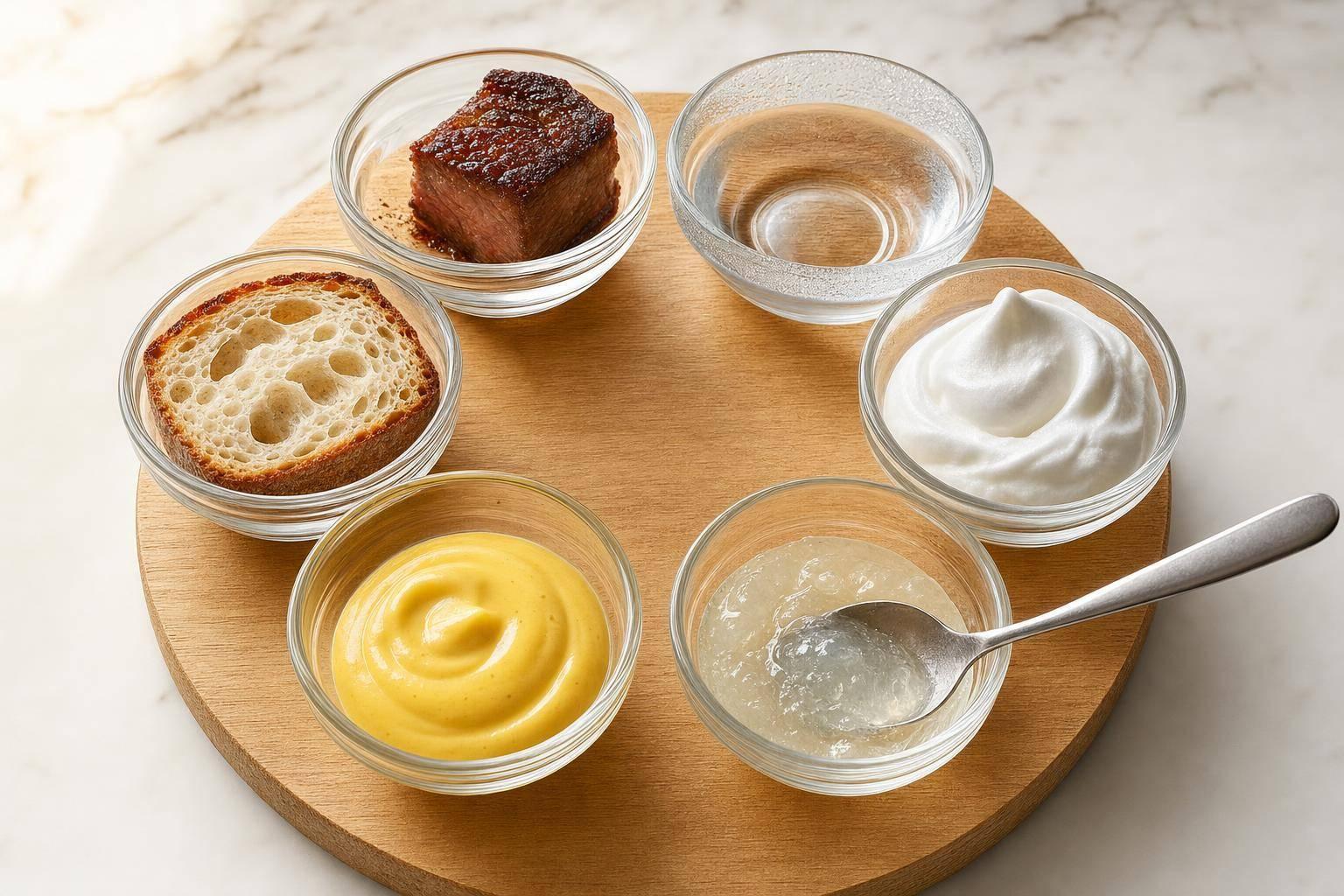
Most cooking mistakes come down to heat, water, protein, starch, fat, or air. If I understand how those six things behave, I can fix a broken sauce, get better browning, keep meat from drying out, and bake bread or cake with the texture I want.
Here’s the short version: dry surfaces brown better, proteins firm up as they heat, starch thickens when it hydrates, gluten changes chew, emulsions need steady handling, and leavening depends on gas plus structure. In many kitchens, even a small shift in temperature matters. For example, Maillard browning often starts around 280°F, while caramelization usually needs 320°F+.
If I had to boil the whole topic down, I’d keep these points in mind:
- Browning is not one thing: Maillard reaction and caramelization happen for different reasons.
- Water slows crust formation: a wet steak steams before it sears.
- Proteins set with heat: eggs, fish, and meat go from soft to firm, then dry if pushed too far.
- Gluten controls chew: more mixing usually means more structure.
- Starch controls thickness: roux, cornstarch, and tapioca do not act the same.
- Emulsions and foams are fragile: too much heat or rough mixing can make them fail.
- Leavening needs gas and support: yeast, baking soda, baking powder, and steam each work in their own way.
- Salt, acid, fat, and heat are daily control points: they shape flavor, texture, and cooking results.
| Topic | What I watch for | Common kitchen result |
|---|---|---|
| Browning | Surface dryness + heat | Better crust and deeper flavor |
| Proteins | Internal temperature | Less toughness, less curdling |
| Gluten | Mixing + resting | Chewy dough or tender crumb |
| Starch | Heat + liquid | Thick sauces and fillings |
| Emulsions/Foams | Mixing + temperature | Stable mayo, hollandaise, meringue |
| Leavening | Gas source + structure | Good rise and crumb |
In short: when I know what heat, moisture, and structure are doing, I stop guessing and start cooking with more control.
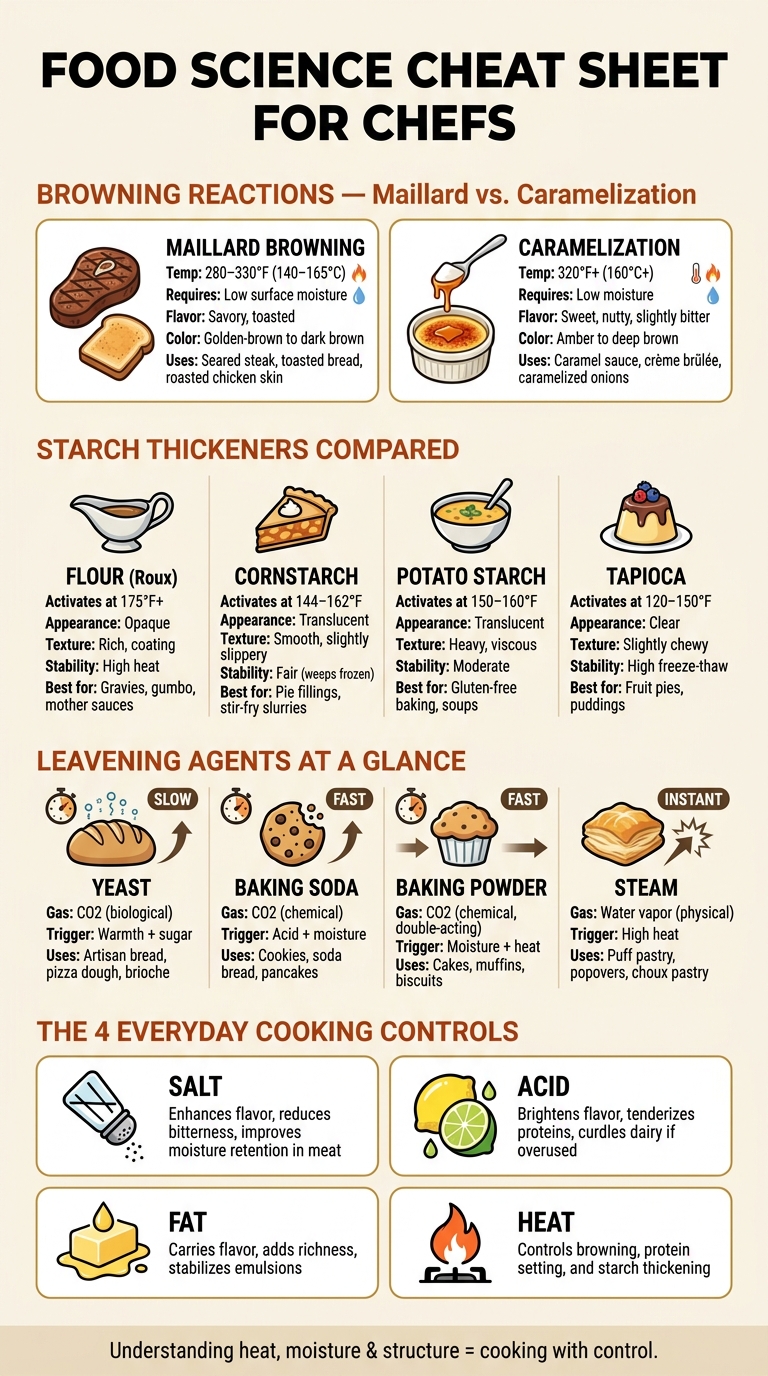
Food Science Cheat Sheet: Key Reactions, Thickeners & Leaveners Every Chef Should Know
Heat and Protein Reactions That Control Flavor and Doneness
Maillard Browning vs. Caramelization
Both reactions make food brown, but they’re not the same thing.
Maillard browning happens when amino acids react with sugars under heat [1]. That reaction gives seared steak, roasted chicken skin, and toasted bread that deep, savory, golden-brown flavor people love.
Caramelization works in a different way. It involves sugar by itself [1]. When you cook sugar for caramel sauce or torch the top of a crème brûlée, the sugar heats until it turns amber and takes on nutty, slightly bitter notes.
Here’s a side-by-side look:
| Reaction | Temp Range (°F / °C) | Moisture Conditions | Flavor & Color Results | Common Uses |
|---|---|---|---|---|
| Maillard Browning | 280–330°F (140–165°C) | Low surface moisture | Savory, toasted; golden-brown to dark brown | Seared steak, toasted bread, roasted chicken skin [1] |
| Caramelization | Above 320°F (160°C) | Low moisture | Sweet, nutty, slightly bitter; amber to deep brown | Caramel sauce, crème brûlée topping, onions |
One point matters a lot in the kitchen: surface moisture blocks browning. If you put a steak into a wet pan, that water has to cook off before Maillard browning can get going. That’s why patting meat dry before searing helps so much. A wet surface slows browning and mutes flavor [1][3].
Protein Denaturation and Coagulation in Eggs, Meat, and Fish
Browning shapes flavor. Protein reactions shape doneness.
When food heats up, proteins first denature, then coagulate into a firmer structure. Push the heat too far, and those proteins tighten up, squeeze out moisture, and leave the food tough. Egg sauces can break. Light, airy mixtures can collapse [1].
An instant-read thermometer takes the guesswork out of this. Use temperature instead of instinct alone to stop overcooking. It helps you check doneness, spot problems, and avoid the dryness and toughness that come from over-coagulation [1][4].
Rest roasted meats before carving so juices redistribute [1].
Next comes structure: how gluten and starch control texture in breads, sauces, and custards.
sbb-itb-7261261
Structure and Texture in Baking, Sauces, and Custards
Gluten Development in Bread, Cakes, and Pastry
Gluten forms when flour proteins meet water. Once you start mixing, those proteins link up. Mix more, and that network gets stronger and stretchier [1].
That’s why pizza dough and cake batter behave so differently. Pizza dough needs a stronger gluten network so it can stretch and hold shape. Cakes need a lighter touch. If you want tender batters or soft pastry dough, mix only until the dry ingredients disappear, then stop. After that, more mixing usually means more chew. Resting and refrigeration matter too, because time changes both dough structure and flavor [1].
Put simply: gluten gives dough elasticity, while starch gives sauces and fillings thickness.
Starch Gelatinization in Sauces and Fillings
If your goal is structure in dough, gluten does the job. If your goal is body in a sauce or filling, starch is what you want.
Starch thickens liquid through gelatinization. As starch granules heat in water, they pull in liquid, swell, and release starch molecules. Those molecules form a thickened network [1][2]. That’s why a roux-based gravy clings to a spoon, and why a fruit pie filling can look glossy and hold a clean slice.
Not all starches act the same. Some make sauces cloudy and rich. Others stay clear and glossy. Some hold up in the freezer, and some don’t.
| Thickener | Approx. Temp Range | Texture | Clarity | Stability | Best Uses |
|---|---|---|---|---|---|
| Flour (Roux) | 175°F+ (80°C+) | Rich, coating | Opaque | High (heat stable) | Gravies, gumbo, mother sauces [1] |
| Cornstarch | 144–162°F (62–72°C) | Smooth, slightly slippery | Translucent | Fair (weeps if frozen) | Pie fillings, stir-fry slurries |
| Potato Starch | 150–160°F (65–71°C) | Heavy, viscous | Translucent | Moderate | Gluten-free baking, soups |
| Tapioca | 120–150°F (50–65°C) | Slightly chewy | Clear | High (freeze-thaw) | Fruit pies, puddings |
A few quick takeaways:
- Flour-based roux makes an opaque sauce with a richer feel and stands up well to heat.
- Cornstarch gives a glossy, translucent finish, but it can turn spongy after freezing.
- Tapioca stays clear and handles freezing well, which makes it a strong pick for fruit pies.
As starch cools, it can start to retrograde. That means the gel network tightens and pushes water out. The result can be graininess or moisture on the surface – a problem called syneresis [5].
Emulsions, Foams, Fermentation, and Leavening
How Emulsions and Foams Stay Stable
Once gluten and starch build structure, the next job is holding fat, air, and gas where they belong.
An emulsion is a stable mix of oil and water held together by an emulsifier. Vinaigrette, mayonnaise, and hollandaise are all emulsions, but each one stays together for a different reason. In mayonnaise and hollandaise, egg yolks do the heavy lifting. In vinaigrette, mustard helps keep the mixture from splitting apart.
Even then, emulsions can break. Heat, time, or rough mixing can push them over the edge. If a dressing separates, a strong shake or a quick whisk will often pull it back together [5]. Egg-based sauces and foams need extra care because pH and temperature can change their texture and stability [1].
Foams deal with the same basic problem, just with air instead of oil droplets. They trap air bubbles inside a protein network. That’s how meringues and soufflés stay puffed up. If that network weakens, the foam falls and the lift disappears [1].
Fermentation and Leavening in Bread and Quick Bakes
Structure matters just as much when gas comes from yeast, baking soda, baking powder, or steam.
Leavening makes dough or batter rise as gas expands before the structure sets. As the bake heats through, gluten and starch firm up around those gas pockets and form the crumb.
Yeast makes CO2 slowly through fermentation as it feeds on sugars in the dough. That gives bread lift, and it also shapes flavor and texture. Baking soda works fast when it meets acid and moisture, which is why it fits batters that go straight into the oven. Baking powder is double-acting, so it releases gas once when wet and again when heated. Steam works in a different way. At high oven temperatures, water vapor expands fast, which helps puff pastry and popovers rise [6].
| Leavener | Gas Source | Trigger | Speed | Common Applications |
|---|---|---|---|---|
| Yeast | Biological (CO2) | Warmth + Sugar | Slow | Artisan breads, pizza dough, brioche |
| Baking Soda | Chemical (CO2) | Acid + Moisture | Fast | Cookies, soda bread, pancakes |
| Baking Powder | Chemical (CO2) | Moisture + Heat | Fast | Cakes, muffins, biscuits |
| Steam | Physical (Vapor) | High Heat | Instant | Puff pastry, popovers, choux pastry |
In gluten-free baking, xanthan gum and similar gums help trap gas and improve crumb [3].
Salt, Acid, Fat, and Heat as Everyday Cooking Controls
After browning, structure, and leavening, these are the controls chefs reach for most.
What Salt, Acid, Fat, and Heat Actually Change
Salt, acid, fat, and heat are the main levers behind almost every dish.
Salt pushes flavor forward, cuts bitterness, and helps meat keep moisture.
Acid sharpens and balances flavor, but too much can curdle dairy and make eggs tighten up.
Fat carries flavor, adds richness, and helps keep emulsions like béarnaise together.
Heat controls browning, setting, and thickening.
Here’s the simple kitchen view of each one:
| Element | Primary Function | Structural Effects | Common Sources | Key Interactions |
|---|---|---|---|---|
| Salt | Enhances flavor; reduces bitterness | Affects protein structure; improves water retention in meat | Sea salt, soy sauce, miso | Balances bitterness; boosts sweetness perception |
| Acid | Brightens flavor; cuts richness | Tenderizes proteins; curdles dairy; affects egg texture | Vinegar, citrus, yogurt, wine | Balances fat; affects enzymatic browning |
| Fat | Carries flavor; provides mouthfeel | Creates emulsions; tenderizes dough by shortening gluten | Butter, oils, animal fats, cream | Helps stabilize emulsions; transfers heat to food |
| Heat | Determines doneness; develops aroma | Drives surface browning; drives starch gelatinization | Stove, oven, grill, sous vide | Drives moisture loss; transforms raw proteins and starches |
Using Food Science to Troubleshoot and Improve Consistency
When a dish goes sideways, one of these controls is usually out of line.
Most kitchen problems come back to moisture, heat, structure, or mixing. If a steak won’t brown, the surface is often too wet or the pan isn’t hot enough. If bread turns out dense, the dough may have weak fermentation or poor structure. If a sauce stays thin, the starch likely never hydrated enough to thicken. If a dressing splits, it usually needs better emulsification or steadier mixing.
Food science helps you find the right fix fast.
FAQs
Why won’t my food brown properly?
Food usually won’t brown the way you want if heat or moisture is off. For searing, a pan that’s not fully preheated gives off a soft, wet sound instead of a steady sizzle. That’s a sign the food is steaming, not browning.
Oven browning can run into the same problem. If your oven is off by 25°F to 50°F, results can change more than you’d think. And dark pans tend to brown food faster than light-colored pans. Preheat your tools first, then watch the food’s color and texture instead of relying only on the timer.
How do I know when proteins are overcooked?
Proteins are often overcooked when they turn tough, dry, rubbery, or stringy instead of staying tender.
With meat, don’t check doneness by slicing into it. That lets juices run out and can leave the final result dry. Use an instant-read thermometer instead, pull the meat off the heat when it reaches the recommended safe temperature, and let it rest for 5–10 minutes so the juices can settle back through the meat.
Which thickener should I use for sauces or pies?
The right thickener depends on the texture you want and the dish in front of you.
For pan sauces, start by scraping up the browned bits, or fond. That’s where a lot of the flavor lives. Then finish with a little butter or cream to give the sauce more body and a richer feel on the tongue.
For sauces or condiments that need more structure, pureed ingredients like vegetables or nuts can do the job well. And when you need the mixture to stay stable, hydrocolloids, gums, or modified starches can help stop separation and give you the viscosity you’re after.
Curious how food science shows up in class? Practice with chef guidance in our cooking classes or the Professional Certificate in the Culinary Arts. Request info and we’ll help you choose a fit.