

Yes, you can do it – but only if your time, money, and home support line up. In most cases, you’ll need to protect 12–20 hours per week for class, study, and kitchen practice, while also planning for tuition, tools, childcare, and lost work time.
Here’s the short version:
- Check your week first. Look at work shifts, school drop-offs, commute time, and who can help at home.
- Pick the right class format. Morning, evening, and online programs each change your work and family routine in different ways.
- Use one calendar for everything. Put class, work, study time, childcare, errands, and rest in one place.
- Plan for the full cost. Tuition is only part of it. Tools can run $500–$1,000, childcare can reach $800–$1,500 per month, and lost work hours can cost $500–$2,000 per month.
- Watch for strain early. If you keep missing class, losing sleep, or running short on money before the month ends, your plan needs to change.
Quick Comparison
| Option | Best For | Schedule | Main Trade-Off |
|---|---|---|---|
| Morning on-campus | People who want to finish faster | Mon–Fri, 8:30 a.m.–1:00 p.m. | Harder if you work days or need daytime childcare |
| Evening on-campus | Full-time workers | Mon–Wed, 5:30 p.m.–10:00 p.m. | Evenings are gone, which affects family time |
| Online live | Parents, remote learners, business owners | Live online for about 4 months | No commute, but less hands-on correction |
I see this as a planning problem, not a motivation problem. If I can match the school format to my job, financing and budget, and family routine, the workload becomes far less likely to spill over into everything else.
sbb-itb-7261261
Set Goals and Pick a School Schedule You Can Keep
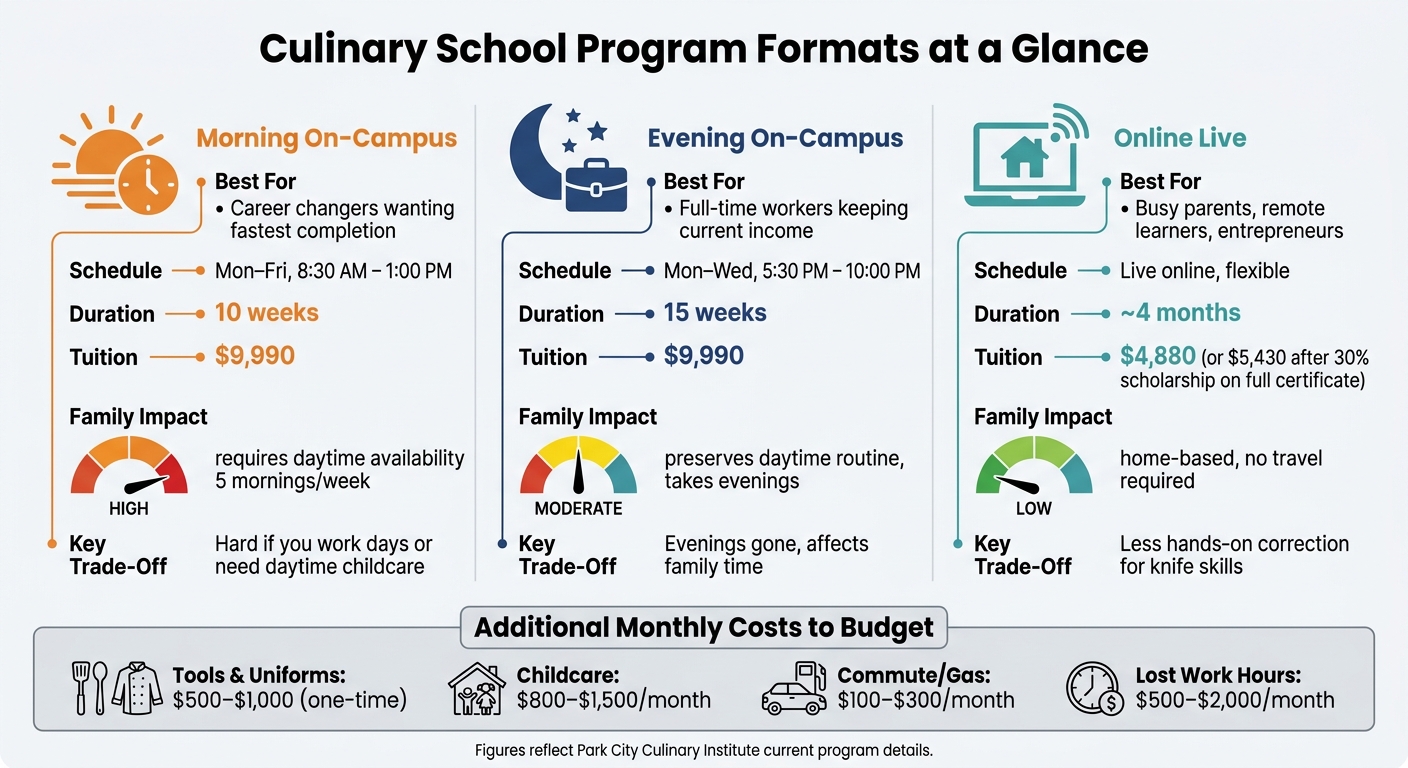
Culinary School Program Formats: Schedule, Cost & Family Impact Compared
Your goal shapes the whole plan. Once you know which hours are locked in, the school format usually gets a lot easier to choose.
Define Your End Goal Before You Build Your Plan
If you’re moving toward a job in a professional kitchen, on-campus training will often make more sense. You get hands-on practice, plus direct feedback on knife control and station setup.
If you’re starting or growing a food business, it may help to pair your culinary training with the 20-hour Culinary Operations & Management course, so you also learn the business side of running a food business [2].
The key point is simple: a career change, a food business, and better home cooking skills do not need the same pace or format. Your plan should fit the time and energy you can honestly give each week. Match your schedule to your deadline, not to some perfect version of life that doesn’t exist.
On-Campus vs. Online Programs at Park City Culinary Institute

The best option depends on your commute, childcare, and work hours, not just tuition.
The evening cohort meets fewer nights each week, but it runs longer. That can make it easier to keep your day job and daytime family routine in place. The online program removes commuting altogether, which can be a solid fit for parents or anyone whose work hours change from week to week.
Use your goal to judge each format by work, childcare, and commute pressure, not by convenience alone.
| Program Format | Best Fit For | Time Savings | Family Impact | Cost Considerations |
|---|---|---|---|---|
| On-Campus (Morning) | Career changers wanting the fastest path to completion | Finishes in 10 weeks; afternoons free | High – requires daily daytime availability, 5 mornings/week | $9,990; add commute and parking costs |
| On-Campus (Evening) | Full-time workers keeping their current income | Finishes in 15 weeks; only 3 nights/week | Moderate – preserves daytime routine, takes evenings | $9,990; allows for steady income during study |
| Online (Live) | Busy parents, remote learners, or entrepreneurs | Zero commute; 4-month duration | Low – home-based learning, no travel required | $4,880; must supply own ingredients and tools |
Program lengths, schedules, and tuition figures reflect current Park City Culinary Institute details [2].
Online formats save travel time, but knife skills and station setup can be harder to fix without in-person feedback [5]. If your goal is work in a professional kitchen, that hands-on correction matters more than ease.
With the format chosen, the next step is to build a weekly plan that protects school time, work time, and family time.
Build a Weekly Plan for School, Work, and Home
Create One Master Calendar for Every Commitment
Once you pick a format, put everything in one place.
A single master calendar should cover work shifts, class sessions, commute time, childcare pickups, study blocks, and rest. That gives you a clear view of where your time is going before the week begins.
A digital calendar works well here. Use color coding for work, class, family, and personal time so overload stands out fast. Add 15- to 30-minute buffers for commuting, parking, and childcare handoffs too. Those small cushions can keep one delay from wrecking the rest of the day.
Use Time Blocking, Batching, and a Weekly Reset
Use time blocking for fixed tasks. Batch errands and meal prep so they don’t eat up your whole week. Then do a Sunday reset to catch conflicts before Monday hits.
Once the schedule is in place, the next job is protecting your energy, home routines, and your budget.
Sample Weekly Routines for Two Common Student Situations
These sample routines show what a realistic week can look like. Start with these, then tweak them based on your work hours, commute, and family needs.
Sample Weekly Routine: Full-Time Worker (Evening Classes)
| Day | Morning (8 AM–12 PM) | Afternoon (12 PM–5 PM) | Evening (5 PM–10 PM) |
|---|---|---|---|
| Mon–Wed | Commute, then work | Work Shift | Culinary Class (5:30 PM–10 PM) [2] |
| Thu–Fri | Commute, then work | Work Shift | Study Block / Family Time |
| Saturday | Rest / Errands | Study / Assignments | Social / Family Time |
This setup can make sense for students who need daytime hours for work and evenings for class.
Sample Weekly Routine: Parent / Part-Time Worker (Morning Classes)
| Day | Morning (8 AM–1 PM) | Afternoon (1 PM–5 PM) | Evening (5 PM–9 PM) |
|---|---|---|---|
| Mon–Fri | Culinary Class (8:30 AM–1 PM) [2] | Part-Time Work / Errands | Family time and childcare [3] |
| Saturday | Family Activities | Study Block | Rest |
"Having the night classes helped. You can jam a lot of credit hours into a little bit of time." – Sabrina Miller, Owner, Sabrina’s Bake Shoppe [3]
Once the week is mapped out, the next pressure points are energy, family expectations, and cost.
Protect Your Energy, Family Relationships, and Budget
Use Recovery Routines to Avoid Burnout
Use the master calendar from the last section to block off recovery time, not just class and work. A packed schedule can wear you down fast, so build simple routines that protect your energy between class, work, and home. Culinary school includes many hands-on hours in real kitchens, which is why proper gear like professional knives and supportive shoes matters [1].
It also helps to keep meals, laundry, and study materials in order so home tasks don’t bleed into study time. Plan short recovery breaks around lab days and long shifts [4].
Once your own energy has a plan, make that schedule visible to the people who rely on it.
Set Clear Expectations With Partners, Kids, and Employers
People can’t support a schedule they haven’t seen. Share your class days and hours early so your household can plan around them. With kids, keep the explanation simple and age-appropriate. If your goal is a career change into private chef work or running your own food business, say that plainly so the time commitment makes sense at home [4].
With your employer, be direct and early. Ask for predictable shifts and point out practical exam weeks ahead of time [1].
Once the household schedule is clear, the next step is making sure the budget still holds up.
Budget for Tuition, Tools, Childcare, and Lost Work Hours
Clear communication helps, but the numbers still need to work. Budget for tuition, tools, childcare, commuting, and lost work hours.
At Park City Culinary Institute, the Professional Certificate in Culinary Arts costs $9,990 for campus and $7,757 online, with the online option now priced at $5,430 after a 30% scholarship [2]. Shorter certificates like the Cuisine or Pastry & Baking programs start at $2,990 online with the scholarship applied [2].
Here’s a simple breakdown of other common costs:
| Expense Category | Typical Cost (USD) | Ways To Reduce Cost |
|---|---|---|
| Tools & Uniforms | $500–$1,000 total | Buy used or ask about student discounts [1] |
| Childcare | $800–$1,500/month | Use evening classes to swap shifts with a partner; lean on family help [3] |
| Commute/Gas | $100–$300/month | Carpool with classmates or choose online options [1] [2] |
| Lost Work Hours | $500–$2,000/month | Choose evening or morning cohorts that fit your main work hours [1] [2] |
| Lab/Exam Fees | $100–$200 per term | Ask whether they are included in tuition [1] |
If tuition, tools, childcare, commute, and lost wages push the plan too far, the balance isn’t workable yet. Starting the FAFSA early and checking whether your current employer offers tuition assistance can cut what you pay out of pocket [1].
Conclusion: Know When Your Plan Works and When to Change It
Once you’ve set your schedule, budget, and support system, daily life becomes the real test. A plan has to hold up through actual weeks, not just look good on a calendar.
Warning Signs You Need to Rework Your Plan
Trouble usually shows up before the whole schedule falls apart. Pay attention to signs like these:
- You miss class, study, or work commitments
- Sleep, meals, or family routines keep falling apart
- Your budget runs short before month end
If several of these show up at the same time, don’t just push harder. The plan itself needs to change.
What a Workable Balance Looks Like
A plan that’s working has a different feel to it. You’re tired some days, but not all the time. Your family knows the schedule, so there’s less chaos and fewer last-minute surprises. Your budget isn’t under strain every week.
You also have backup childcare or family help when needed. Your course load stays manageable, and you check your calendar often enough to catch problems before they snowball. Most of all, your reason for being in culinary school still feels worth the effort.
If a slower schedule helps protect your job and family life, go with the option you can stick with week after week. The goal is a routine you can repeat without draining your energy, straining your relationships, or pushing your budget too far.
FAQs
How do I know if culinary school fits my schedule?
Start by looking at three things: your time, your money goals, and how each program is set up. If you plan to keep working, focus on options with evening, weekend, or hybrid schedules.
Ask for a sample weekly schedule so you can see how much time labs and lectures take. That small step can save you a lot of stress later.
It also helps to compare programs based on:
- Commute
- Program length
- Kitchen hours
And if you can, talk with current students. They can give you a straight answer about what it’s like to balance school, work, and family at the same time.
Which class format works best if I have kids and a job?
Evening classes are often the most practical option if you’re balancing a job and children. They can help you keep working while leaving more daytime hours open for family responsibilities.
If possible, look for programs with morning, afternoon, and evening options, or a hybrid format that puts some theory work online. The best schedule is the one that fits your family’s routine.
What should I do if my plan starts falling apart?
If your plan starts to fall apart, move fast and let the school know what’s going on. When attendance becomes a problem, you may be able to make up up to four classes per term by joining the same sessions on other dates or finishing labs online.
Too many absences can affect graduation, so talk with faculty and admissions early so the Director can review your situation. And if you want to cut down on stress later, meal-prep planners can save time and make your routine a lot easier.