

If your kitchen is small, the best buys are simple: stackable clear containers, a compact vacuum system, pull-out organizers, wall storage, and labels or app tracking. Those five tool types fix the biggest problems in tiny kitchens: wasted space, hidden food, crowded shelves, and food spoilage.
Here’s the short version:
- For fridges and freezers: use compact vacuum containers or flat vacuum-sealed bags to save shelf space and keep portions easy to spot.
- For pantries: use clear square containers with labels so you can stack up, not out.
- For food waste: use digital inventory tools or date labels to track what you have before it expires.
- For cabinets: use pull-out inserts, under-sink organizers, and divider systems so deep spaces stop wasting room.
- For counters: use wall racks, magnetic strips, or a fold-down prep surface to free up work space.
A few facts stand out from the article: fold-down prep surfaces can improve small-kitchen use by nearly 30%, and flat, labeled freezer packs make it far easier to stack and rotate food. That means less digging, fewer forgotten leftovers, and less waste.
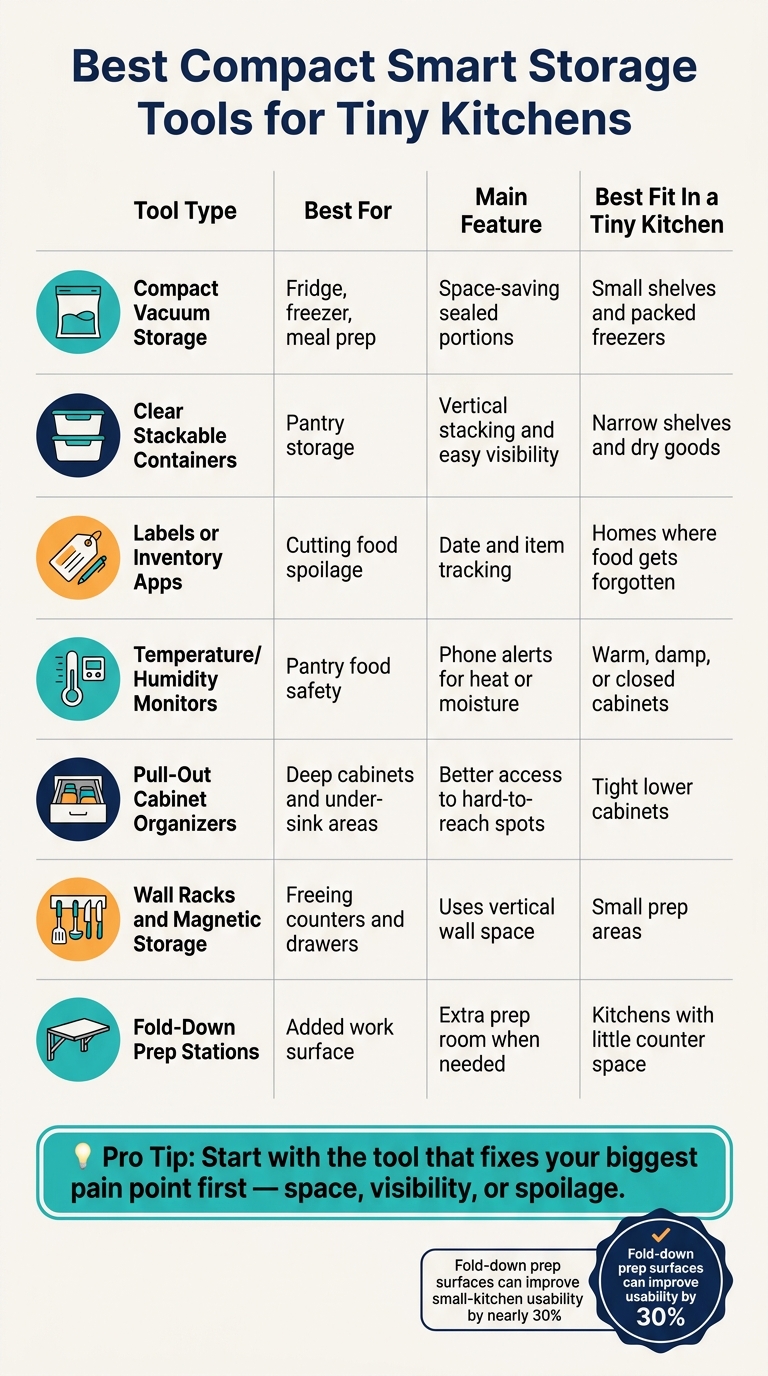
Best Compact Smart Storage Tools for Tiny Kitchens: Quick Comparison Guide
Tiny Kitchen? Try These 6 Smart Storage Hacks That Save Massive Space! 🤯
sbb-itb-7261261
Quick Comparison
| Tool type | Best for | Main feature | Best fit in a tiny kitchen |
|---|---|---|---|
| Compact vacuum storage | Fridge, freezer, meal prep | Space-saving sealed portions | Small shelves and packed freezers |
| Clear stackable containers | Pantry storage | Vertical stacking and easy visibility | Narrow shelves and dry goods |
| Labels or inventory apps | Cutting food spoilage | Date and item tracking | Homes where food gets forgotten |
| Temperature/humidity monitors | Pantry food safety | Phone alerts for heat or moisture | Warm, damp, or closed cabinets |
| Pull-out cabinet organizers | Deep cabinets and under-sink areas | Better access to hard-to-reach spots | Tight lower cabinets |
| Wall racks and magnetic storage | Freeing counters and drawers | Uses vertical wall space | Small prep areas |
| Fold-down prep stations | Added work surface | Extra prep room when needed | Kitchens with little counter space |
If I had to keep it even simpler, I’d say this: start with the tool that fixes your biggest pain point first. If you waste food, buy tracking and labels. If you can’t find room, buy vertical storage and pull-outs. If your fridge is packed, start with vacuum storage.
That’s the main idea of the article in one line: buy fewer tools, but pick the ones that fix space, visibility, and spoilage first.
Best smart food storage systems for fridges, freezers, and meal prep
Small fridges need storage that saves space and keeps food easy to see. That’s why compact vacuum storage is the best place to start.
Zwilling Fresh & Save: vacuum containers and app tracking
Zwilling Fresh & Save pairs vacuum containers with app tracking, which helps you see what you packed, what expires first, and what to use next. It takes some of the guesswork out of meal prep. Instead of digging through the fridge and hoping for the best, you can check what’s there and use food before it gets forgotten.
This same compact setup also works well for freezer portions, which is a big plus when space is tight.
Compact vacuum sealers for smaller freezer and fridge packages
For smaller freezer and fridge packages, use vacuum-sealed portions, flattened bags, and clear date labels. That simple combo helps items stack neatly and move in and out without turning the freezer into a mess.
The best setup uses flat, labeled packages that stack cleanly and rotate fast. In plain English: less digging, less waste, and fewer leftovers disappearing into the back of the shelf. If you’re setting up a small-space system, start with a compact vacuum option since it saves space and makes leftovers easier to track.
Best stackable containers, tracking tools, and monitors for pantry control
With the fridge and freezer sorted, the pantry is the next place to get under control. Dry goods can take over a small kitchen fast, so a clear setup helps you avoid buying doubles and forgetting what’s already there.
Clear, stackable containers for vertical pantry storage
Go with square or rectangular containers with flat lids. They stack better, fit tighter, and leave less shelf space unused. Clear sides make it easy to see what you have without dragging everything off the shelf.
It also helps to add reusable labels or QR labels for contents and dates. That way, you can tell what’s inside and how long it’s been there in a second.
Pair containers with labels so contents and dates stay visible at a glance.
App-based tracking and temperature monitors for food safety
App-based inventory tracking can help you log what you have and flag low-stock items before you run out. It’s a simple way to keep tabs on pantry staples without relying on memory alone.
If your pantry tends to run warm or damp, add a Wi‑Fi or Bluetooth temperature-humidity monitor. It sends real-time alerts to your phone, so you can catch heat or moisture issues without opening the cabinet.
Once the pantry is visible and labeled, monitoring gets much easier. The best setup brings together stackable containers, clear labels, and a simple monitor for heat or humidity.
Best organizers and multifunction tools that free up cabinets and counters
Once your food is sorted, the next step is simple: take back the space it’s been hogging. The right organizers don’t just make a kitchen look neater. They help you get usable room back from packed drawers, cluttered counters, and those deep cabinets where things seem to vanish.
Pull-out cabinet systems, wall racks, and magnetic storage
Pull-out inserts, blind-corner carousels, and divider drawers make deep cabinets far easier to use. Instead of digging through a dark back corner, you can slide things out and see what you have. Pull-out systems and under-sink organizers also recover wasted inches in deep or awkward spots.
Wall-mounted racks for pots and pans and magnetic strips for knives free up both counter and drawer space [1]. Magnetic strips are especially handy in rental kitchens because they’re low-commitment, while wall-mounted racks tend to feel a bit more semi-permanent [1].
Think of cabinet walls, corners, and vertical surfaces as working storage areas, not wasted space. Inside cabinets, integrated lift systems, baskets, and smart lighting can also help recover room within the space you already have [2].
Prep stations and clean, contact-light storage
Once you’ve freed up cabinet space, add only the prep surface you’ll actually use. A compact island or fold-down prep table can work well as a prep station when needed. In small kitchens, fold-down prep surfaces can improve usability by nearly 30% [1].
Conclusion: Which compact smart storage tools are worth buying
After looking at fridge, pantry, and cabinet tools side by side, the best pick comes down to one thing: what problem is slowing you down most.
Start there.
If your biggest issue is storage clutter, go with the tools that open up space first. Vertical organizers, wall racks, and pull-out cabinet systems can clear crowded counters fast. If food waste is the bigger headache, begin with smart labels and digital inventory tools so you can keep track of perishables before they go bad.
A smart starter set looks like this:
- Stackable clear containers for better pantry visibility
- At least one vertical organizer to take back cabinet or wall space
- Smart labels or a digital inventory system if food waste keeps happening
- Multifunction tools if your main goal is faster meal prep
Use this guide to match the goal with the right tool category.
| Goal | Best Tool Category |
|---|---|
| Reclaim space | Vertical organizers, wall racks |
| Reduce spoilage | Smart labels, digital inventory tools |
| Improve visibility | Stackable clear containers |
| Speed up prep | Multifunction prep stations |
That same logic shows up in culinary training at Park City Culinary Institute, where portion control and waste reduction are core habits.
Start with one category, test what it fixes, and add more only if you need them. In a tiny kitchen, the win usually comes from choosing the right tools – not buying every tool.
FAQs
Which tool should I buy first?
Start with a compact storage piece or small appliance that saves space and does more than one job. In a tiny kitchen, the Ninja SP101 Digital Air Fry Countertop Oven is a smart first buy. Its flip-up design cuts depth use by over 60%, and it can stand in for several appliances, including an air fryer, toaster, and dehydrator.
If you want to sharpen your kitchen skills, Park City Culinary Institute offers professional certificates and recreational classes that can help you get more out of tools like these, no matter how much space you have.
Are smart storage tools worth it in a tiny kitchen?
Yes. Smart storage tools and multi-use appliances can make a big difference in a tiny kitchen.
They help you make the most of vertical space with options like floating shelves and ladder bookshelves. And compact appliances can replace several single-use gadgets, which frees up more counter space.
How do I keep food visible without cluttering shelves?
Use clear storage and make the most of vertical space. Clear glass jars make it easy to check pantry staples at a glance, so you don’t have to shuffle things around to see what’s running low.
In the fridge, flat interiors or side lighting can cut down on blind spots. Open shelving or modular carts with tilted trays can also keep everyday ingredients visible and neat.
Related Blog Posts
- Kitchen Setup Checklist for New Culinary Students
- Best Seasonal Ingredients to Preserve Each Month
- Portion Control Checklist for Private Chefs
- 5 Tips for Balancing Seasonal and Year-Round Ingredients
Ready to practice kitchen organization and technique hands-on? Explore cooking classes in Salt Lake City and Park City or the Professional Certificate in the Culinary Arts at Park City Culinary Institute.