
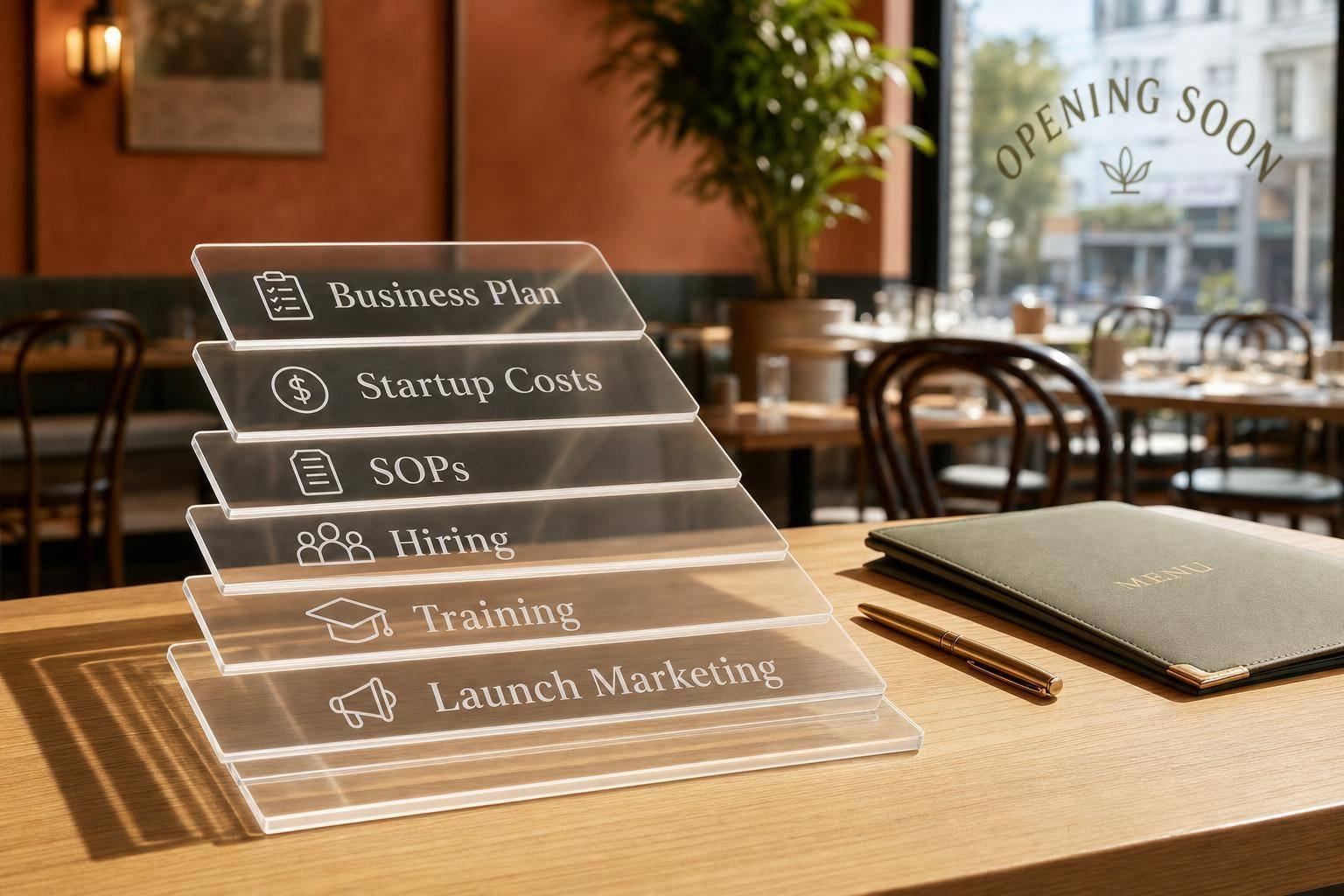
Complete Guide to Opening Your First Restaurant
Opening a restaurant is exciting for the same reason it’s risky: you’re combining creativity, operations, finance, hospitality, and marketing in one business that has very little room for guesswork.
The video behind this guide makes one point especially clear: your first restaurant should not begin with a logo, a lease, or even a menu item. It should begin with a disciplined business plan. Not a document you create for a lender and forget, but a working blueprint that shapes concept, costs, training, systems, and launch strategy.
For home cooks dreaming of turning passion into a profession, career changers entering hospitality, or entrepreneurs testing a first food concept, that idea matters. A restaurant is not just "good food plus customers." It’s a system. And the stronger that system is before opening day, the more likely you are to survive the first year.
This article distills the video into a practical framework and adds context around why each step matters.
sbb-itb-7261261
Key Takeaways
- Start with concept clarity, not kitchen enthusiasm. Define your target customer, service model, menu focus, pricing, and guest experience before spending heavily.
- Build a business plan that actually guides decisions. It should cover concept, capital needs, revenue assumptions, staffing, SOPs, and marketing timelines.
- Know who you serve and who you don’t. A strong restaurant concept is specific; trying to please everyone usually weakens the brand.
- Use conservative financial assumptions. Model sales, cover counts, average check, food cost, labor, and operating expenses over at least three years.
- Treat SOPs as non-negotiable infrastructure. Standards for product, service, facilities, and safety create consistency and protect margins.
- Train before you need performance. Orientation, menu knowledge, position training, and leadership development should be mapped before opening.
- Practice with soft openings. They reduce risk, reveal problems early, and give staff a chance to improve before the public rush.
- Begin marketing months before launch. Brand identity, digital assets, community visibility, and opening-week planning should happen in stages.
- Respond to feedback instead of fearing it. Early complaints often reveal operational blind spots you can still fix.
- Think like an operator, not just an owner. The restaurant has to function daily, not just look promising on paper.
Why First-Time Restaurant Owners Get Into Trouble
Many new operators underestimate what "opening" really means. They assume the hard part is raising money, designing the space, or perfecting recipes. Those matter, but the bigger challenge is integration.
A first restaurant succeeds when these five pieces work together:
- A clear concept
- A realistic financial model
- Operational systems
- Hiring and training discipline
- A structured launch plan
When one of these is weak, the others suffer. For example:
- A vague concept leads to a confused menu
- A confused menu drives food cost and labor inefficiency
- Weak training creates inconsistent service
- Inconsistent service undermines marketing
- Poor marketing creates traffic swings that make labor and inventory harder to manage
That’s why the video focuses so heavily on planning. It’s less about inspiring a dream and more about reducing avoidable mistakes.
Step 1: Define a Restaurant Concept That Can Actually Operate
A concept is more than cuisine. It’s the answer to a chain of practical questions:
- Who is the customer?
- What occasion are they dining for?
- What service level will they receive?
- What atmosphere should they expect?
- What signature items will make the restaurant memorable?
- What price point fits the market?
Those questions sound basic, but they force discipline. A restaurant that says it wants to be upscale, family-friendly, fast, affordable, and chef-driven is probably not a concept yet. It’s a wish list.
Start with the target audience
The speaker emphasizes understanding where your guests come from and what niche you serve. That’s especially important in the U.S. market, where local dining patterns can vary dramatically by neighborhood, commute habits, household income, and daypart behavior.
Useful research sources mentioned in the video include:
- Public data
- Chambers of commerce
- Real estate insights
- Industry reports
- Competitive analysis tools
What matters is not collecting data for its own sake, but turning it into decisions. For example:
- If your area has heavy office traffic, lunch speed may matter more than elaborate plating.
- If you’re in a suburban family market, parking and kids’ menu strategy may be more important than cocktail innovation.
- If you’re targeting celebratory dining, ambiance and service ritual likely matter as much as food.
Decide on your service model early
The video identifies several possible formats:
- Self-service
- Limited service
- Full service
- Hybrid models
This is a critical decision because it affects nearly everything else:
- Labor model
- Menu design
- Kitchen flow
- Table turns
- Average check
- POS needs
- Training standards
A first-time owner often chooses service style based on preference instead of feasibility. But a full-service restaurant demands much more management structure than many first operators anticipate. If your margins, staffing pipeline, or experience level are limited, a simpler model may be the smarter launch path.
Define what makes you different
The video repeatedly returns to unique selling propositions. In practice, this means answering: Why would someone choose you over other options?
Your differentiator might come from:
- Signature menu items
- Distinct ambiance
- Service style
- Price-value positioning
- Convenience
- Local identity
- Strong breakfast, brunch, or late-night niche
The key is specificity. "Great food and great service" is not a differentiator. Every restaurant claims that.
Just as important: define what you are not
One of the most useful ideas in the video is that defining what you are not matters as much as defining what you are.
That’s excellent advice.
First-time owners often over-expand the concept before opening:
- adding menu items for everyone
- stretching into too many dayparts
- offering services they can’t yet execute well
- diluting brand identity to avoid excluding customers
But clarity creates efficiency. Restraint protects quality. A restaurant with a narrow, strong identity often performs better than one trying to cover every occasion.
Step 2: Build the Financial Model Before the Emotion Takes Over
Restaurants are emotional businesses for owners and transactional businesses for cash flow. If your numbers don’t work, your passion won’t rescue the model.
The video breaks financial planning into two main parts:
- Capital requirements
- Revenue and profit projections
Capital planning: know what opening will really cost
The speaker lists several startup cost categories:
- Real estate and lease-related costs
- Back-of-house equipment
- Professional services
- Opening expenses
- Inventory
- Marketing
- Personnel
That list is important because new operators often focus on construction and equipment while underestimating "soft" costs like pre-opening payroll, marketing setup, training time, and professional fees.
A practical takeaway
Build a startup budget that includes both visible and hidden costs. If it takes money before the first guest walks in, it belongs in the opening budget.
The video also mentions maintaining a contingency budget, with member experience suggesting roughly 8% for construction, fixtures, and equipment overruns. That’s a practical safeguard. Delays and change orders are common, and undercapitalized restaurants are vulnerable before they even launch.
Revenue projections: optimism is not a strategy
The speaker recommends projecting out three years and identifying assumptions such as:
- Sales growth rate
- Cover counts
- Average check
- Food cost
- Beverage cost
- Labor cost
- Operating costs
- Rent
- Working capital
- Projected profit
This is where many first restaurant plans become fantasy documents. The issue isn’t ambition; it’s unsupported assumptions.
What "conservative" really means
The video references sample growth assumptions such as 8% in the first two years and 5% after. That’s useful as an example, but not a rule. The broader lesson is to avoid building your business on best-case traffic from day one.
A conservative model should ask:
- What if weekdays lag?
- What if dinner is strong but lunch is weak?
- What if hiring takes longer?
- What if average check falls below expectation?
- What if labor runs high in the first months?
- What if marketing awareness builds slowly?
If your model only works when everything goes right, it’s fragile.
Prime cost is your early warning system
The speaker notes that prime cost – generally cost of goods sold plus labor – often lands around the 60% to 65% range in the planning model mentioned.
That matters because prime cost is one of the clearest indicators of operational health. Even if exact benchmarks vary by concept, every first-time operator should understand this:
- Menu pricing affects food cost leverage
- Staffing levels affect labor cost
- Sales volume affects whether labor becomes productive
- Poor prep systems, waste, or overportioning can quickly destroy margins
In other words, finance doesn’t sit apart from operations. It is operations.
Step 3: Turn the Concept Into Systems With SOPs
One of the strongest parts of the video is its emphasis on standard operating procedures, or SOPs.
A lot of new owners think standards can wait until after opening. In reality, opening without standards is like launching a kitchen without recipes and hoping instinct will keep things stable.
The speaker frames SOPs through three layers:
- Policy: your stance
- Standard: the expectation
- Procedure: the step-by-step method
That distinction is useful because it prevents vague management. Saying "we care about responsible alcohol service" is not enough. Staff need to know the exact standard and exact steps.
The four major SOP categories
1. Product-related standards
These include:
- Portion size
- Serving temperature
- Garnishes
- Condiments
- Recipe execution
This category protects both quality and cost. Without product standards, consistency drops and food cost rises. For new operators, recipe cards and prep procedures are not administrative extras – they’re margin tools.
2. Employee-related standards
These cover service expectations such as:
- How guests are greeted
- Phone etiquette
- Drive-thru interactions, if applicable
- Timing across the guest journey
- Service behavior at each stage
The video breaks the guest experience into touchpoints like pre-arrival, arrival, ordering, service, payment, and departure. That’s a smart framework because it helps you design hospitality intentionally instead of reactively.
3. Facility standards
This includes:
- Design consistency
- Lighting
- Décor
- Sound level
- Temperature
- Environmental expectations
These details often get dismissed as "feel", but they shape perception. A restaurant’s physical environment communicates the brand every minute, even when staff say nothing.
4. Safety standards
This category includes:
- Team safety
- Guest safety
- Public health procedures
- Facility safety
- Security
For first-time owners, safety often gets narrowed to food handling alone. The video smartly broadens it to include building procedures and after-hours security. That’s the mindset of an operator, not just a chef-owner.
Step 4: Build Daily Tools, Not Just Policies
A useful distinction in the video is the move from broad SOPs to practical tools.
A restaurant doesn’t run on ideals. It runs on repeatable checklists and documents.
Examples mentioned include:
Front-of-house tools
- Opening checklists
- Cleaning routines
- Restroom checks
- Bar controls
- Liquor inventory procedures
Back-of-house tools
- Recipe cards
- Waste sheets
- Prep sheets
- Freezer pulls
- Production tracking
This matters because many first-time operators stop at "training people well." But people perform better when systems reduce guesswork.
A simple rule: if a task must happen consistently, give it a visible tool.
Step 5: Hire for Culture, Then Train for Performance
Restaurants often hire under pressure. The result is predictable: filling positions quickly, then hoping people adapt.
The video argues for a more deliberate approach, beginning with interview questions that test cultural fit and operational readiness.
That’s especially important in a startup restaurant, where early team members do more than fill shifts. They help define the habits of the business.
What your training program should include
The video outlines a training flow that includes:
- General orientation
- Position-specific orientation
- Menu training
- Team member training
- Management training
That sequence is stronger than the common "shadow someone and figure it out" model.
Orientation sets the tone
This is where owners explain:
- Why the restaurant exists
- What experience it aims to create
- What standards matter most
- How team members contribute to the concept
That cultural framing is essential. Without it, staff may memorize tasks but never understand the brand.
Menu training should go beyond memorization
The video mentions allergen knowledge and front-of-house fluency. That’s an important point. Guests increasingly expect staff to answer informed questions about ingredients, modifications, and dietary concerns.
Back-of-house training, meanwhile, must focus on repeatable execution, not just culinary talent. Great restaurant cooking at scale depends on systems, timing, and consistency.
Managers should not be exempt from foundational training
The speaker notes that managers should complete the same core team member training as everyone else. That’s operationally sound. Leaders can’t coach standards they haven’t practiced.
Step 6: Assemble the Right Leadership Team
The video recommends identifying key leadership roles in advance, such as:
- General manager
- Assistant general manager
- Training manager
Not every first restaurant will have all of these roles, and the exact structure was not specified in detail in the video. But the larger point stands: leadership cannot be improvised after opening.
Investors, partners, and even staff gain confidence when responsibilities are clear.
A leadership team should answer:
- Who owns guest experience?
- Who owns labor?
- Who owns training?
- Who owns inventory and ordering?
- Who handles opening and closing accountability?
- Who resolves operational breakdowns?
When those answers are fuzzy, problems float until they become expensive.
Step 7: Treat Supplier Strategy as a Business Decision
The video briefly reviews several sourcing approaches:
- Competitive quotes
- Standard orders
- Prime vendor relationships
- Cost-plus models
- Sealed bids
- Commissary arrangements
For a first restaurant, this is more important than it sounds. Supplier choice affects:
- Cost stability
- Product consistency
- Delivery reliability
- Credit terms
- Ordering simplicity
- Time spent managing inventory
New operators sometimes chase lowest unit price without considering hidden labor costs or inconsistency. A slightly higher-priced vendor with reliable service and standardized ordering may be more profitable overall.
If you’re building a concept with multiple moving parts, supplier simplicity can be a competitive advantage.
Step 8: Market the Restaurant in Phases, Not All at Once
One of the most practical sections in the video is the six-stage marketing timeline. Rather than treating marketing as an opening-week activity, it frames marketing as a staged rollout.
That’s a strong approach because restaurants rarely open into instant awareness. Traffic usually builds through repeated exposure.
A six-stage marketing roadmap
Six months out: build the foundation
At this stage, focus on:
- Brand identity
- Digital asset ownership
- Website planning
- Early buzz creation
The insight here is that your identity should be settled before you start broadcasting. If your brand voice, visuals, and concept keep changing, early awareness can become confusion.
Three months out: create awareness
The video recommends:
- Launching social profiles
- Sharing behind-the-scenes content
- Participating in local events
- Building cross-promotions
- Starting media outreach
This stage is about visibility and familiarity. People are more likely to try a new restaurant if they feel they’ve already watched it come to life.
Two months out: prepare the launch assets
This phase includes:
- Professional photography
- Planning soft openings and grand openings
- Media preparation
- Staff readiness for public-facing messaging
A smart addition from the speaker is the idea of training key staff on a consistent "elevator pitch." That matters because mixed messaging can weaken brand confidence before you even open.
One month out: push promotion
Now the goal shifts toward activation:
- Exclusive pre-opening offers
- Targeted local advertising
- Community-based promotion
- Charity or neighborhood engagement
- Final event planning
The video wisely stresses local grassroots outreach in addition to digital promotion. That’s especially relevant for independent restaurants, where neighborhood familiarity often drives early momentum.
Opening week: launch carefully
The speaker strongly favors soft openings before a full public push. That advice is worth highlighting.
A soft opening is not just a marketing event. It’s an operational stress test.
It gives you the chance to evaluate:
- Ticket times
- Service flow
- Menu clarity
- POS issues
- Staffing gaps
- Guest confusion points
- Leadership communication
The more issues you catch here, the less damage you do when reviews start appearing publicly.
Post-opening: sustain momentum
After launch, the work changes again. The video points to:
- Active social media
- Email and loyalty efforts
- Marketing calendars
- Community participation
- Ongoing sales monitoring
- Adjustments based on results
This is important because many new restaurants spend heavily to open, then go quiet. But post-opening consistency is what turns trial into habit.
Step 9: Learn From Common Marketing Mistakes
The video cites several mistakes operators report making:
- No clear plan
- Neglecting social media
- Underestimating visuals
- Ignoring reviews
- Overusing discounts and coupons
These are worth unpacking.
No clear plan
Without a timeline, marketing becomes reactive. You end up posting randomly, promoting inconsistently, and missing local opportunities.
Neglecting social media
Even if your audience isn’t highly trend-driven, many guests still check social channels for signs of life, menu previews, and proof that the business is real and current.
Weak visuals
In restaurants, visuals do more than attract attention. They set expectation. Poor imagery can make strong food look forgettable.
Ignoring reviews
Early reviews are operational intelligence. Even unfair reviews can reveal recurring confusion or unmet expectations.
Overusing discounts
Discounting can drive traffic, but it can also train customers to wait for deals and undermine the perceived value of your concept. A new restaurant should build demand through clarity and execution, not just price cuts.
A Useful Operating Mindset: Every Decision Connects
What makes the video especially valuable is not any single tip, but the framework underneath it: concept, finance, operations, and marketing are interdependent.
Here’s what that looks like in practice:
- Your concept shapes your menu
- Your menu shapes food cost and labor
- Your labor model shapes service standards
- Your standards shape training
- Your training shapes guest experience
- Your guest experience shapes reviews
- Your reviews shape marketing efficiency
- Your marketing shapes sales stability
- Your sales stability shapes whether the business survives
That chain is why first-time restaurant owners benefit from structured learning and practical systems. Talent helps. So does passion. But repeatable processes are what allow talent and passion to scale.
Final Thoughts
Opening your first restaurant is less about having one brilliant idea than about making hundreds of disciplined decisions that support one another.
The video’s biggest lesson is simple: don’t treat the business plan as paperwork. Treat it as your operating playbook. It should clarify your concept, stress-test your finances, define your standards, guide your training, and pace your marketing.
If you’re planning your first venture, start by answering the hard questions before the lease is signed and the doors open:
- Who exactly are we for?
- What experience are we promising?
- What systems will keep that promise consistent?
- What financial assumptions are we betting on?
- How will we train people to execute the concept?
- How will we build awareness before opening day?
Restaurants rarely fail because the owner cared too much. They fail because the systems weren’t ready for the reality of service.
Get the foundation right, and your opening becomes more than a launch. It becomes the start of a business built to last.
Source: "Start Strong: The Savvy Guide to Opening Your First Restaurant" – Louisiana Restaurant Association, YouTube, Jan 1, 1970 – https://www.youtube.com/watch?v=c_lLBrJ2Xy8