

Yes – you can get browned, crisp-edged vegetables without oil. What matters most is a hot oven (425°F), a dry surface, a preheated pan for about 10 minutes, and space between the pieces.
Here’s the short version: if your vegetables are wet or crowded, they steam. If they’re dry, cut with flat sides, and spread in one layer, they brown. I’d also season in two steps: dry spices before roasting, then lemon juice, vinegar, zest, or herbs after.
What I’d keep in mind right away:
- Dry well after washing
- Cut evenly so pieces cook at the same speed
- Use a bare metal pan for the most color
- Roast on the center rack
- Flip once after 10 to 20 minutes
- Use two pans for big batches
- Pull them when browned in spots and fork-tender
A few numbers help: broccoli steaks usually take 20 to 25 minutes, carrots 25 to 30 minutes, potatoes 35 to 45 minutes, and cauliflower about 40 minutes. The goal is simple: less steam, more pan contact, more browning.
This method works because browning comes from heat + dryness + contact, not just fat.
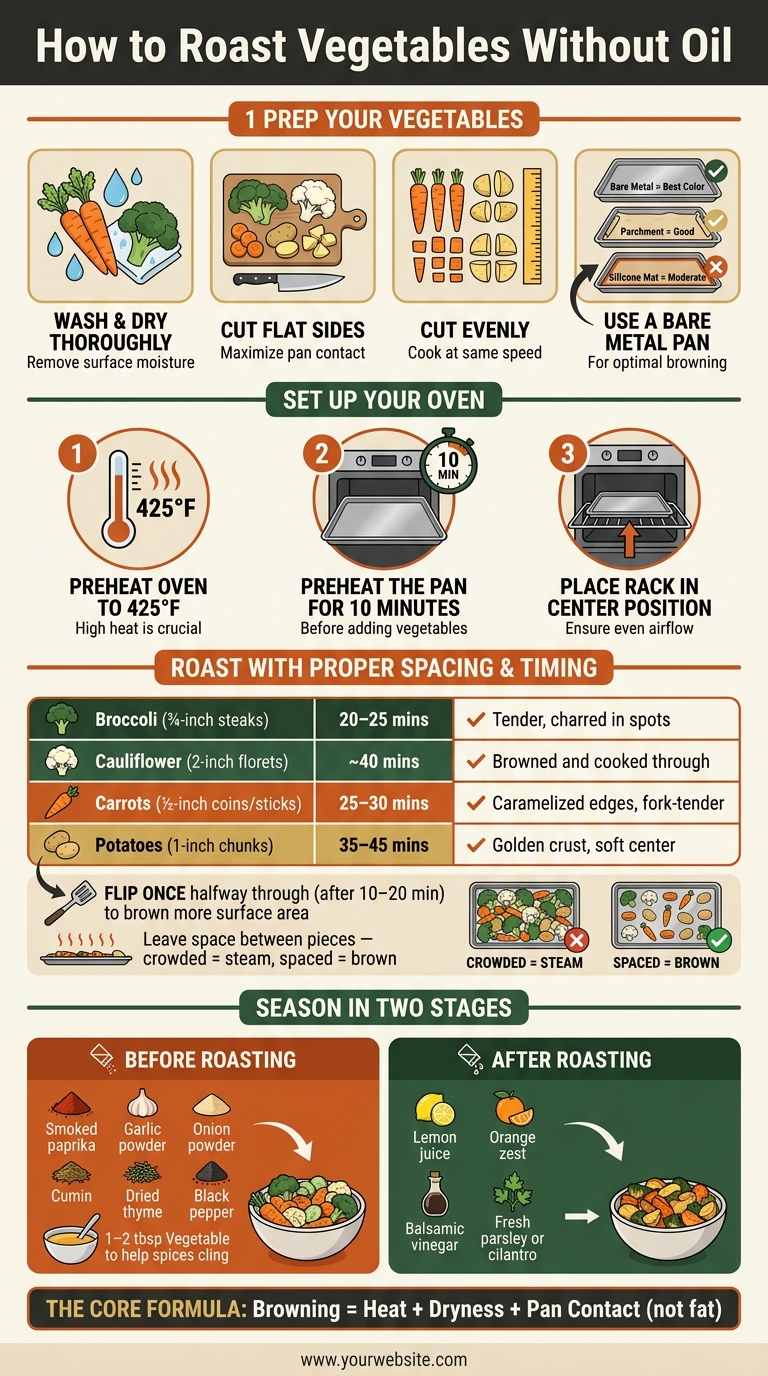
How to Roast Vegetables Without Oil: Step-by-Step Method
Sheet Pan Roasted Vegetables Oil Free
sbb-itb-7261261
Prepare vegetables for browning before they go in the oven
Good prep is the difference between vegetables that brown and vegetables that just steam. Before anything hits the oven, cut the vegetables so they have flat sides that can sit against the pan. Then dry them well after washing.
How to cut and dry broccoli, carrots, cauliflower, and potatoes
For broccoli, slice the head lengthwise into ¾-inch-thick "steaks", keeping about 3 inches of stem attached. That flat cut side is what forms the crust [1]. For cauliflower, cut the head into even 2-inch florets so the outside browns before the inside turns mushy [2]. Cut carrots and potatoes into even pieces too, so they cook at the same pace. And yes, dry all vegetables thoroughly before they go into the oven.
Flat cuts help. But the amount of pan contact is what decides how much color you get.
Bare pans, parchment paper, or silicone mats: which to use
Without oil, the pan surface matters more because it affects both browning and sticking. Some surfaces give you more color. Others make cleanup easier.
| Surface | Browning | Cleanup |
|---|---|---|
| Bare metal pan | Best | More effort |
| Parchment paper | Good | Easy |
| Silicone mat | Moderate | Easy |
A bare heavy-gauge metal pan gives the most direct contact with heat and produces the best crust [1]. Preheat the pan in a 425°F oven for about 10 minutes before adding the vegetables. That hot surface helps do some of the work oil would usually do by cutting down on sticking.
Parchment paper keeps vegetables from sticking and makes cleanup simple, with only a slight drop in direct browning [2]. A silicone mat is convenient too, but it insulates the surface more, so you get less crust.
Once the vegetables are cut, dry, and spaced out on the right surface, the oven can do its part.
Use heat, spacing, and timing to avoid soggy vegetables
Once your vegetables are dry and your pan is hot, spacing and timing make the big difference between roasting and steaming.
Set your oven to 425°F and place the baking sheet inside for about 10 minutes before you add the vegetables [1]. Then spread the pieces in a single layer with a little room between them. If they’re packed too close, they give off steam and soften instead of browning. A shallow sheet pan works best here, since high sides hold in steam and slow down browning. Got a big batch? Use two pans instead of stacking everything on one.
Oven temperature, rack position, and when to flip
For one sheet pan, use the center rack. It gives the most even heat. Flip the vegetables once halfway through, usually after 10 to 20 minutes [1][2]. That flip matters more than it seems. It puts a new side against the hot pan, which helps more of the surface brown.
Roasting times by vegetable
Use these as starting points, then go by color and texture:
| Vegetable | Cut | Time Range | Key Doneness Cues |
|---|---|---|---|
| Broccoli | ¾-inch-thick steaks | 20–25 mins | Tender and charred in spots [1] |
| Cauliflower | 2-inch florets | About 40 mins | Browned in spots and cooked through [2] |
| Carrots | ½-inch coins or sticks | 25–30 mins | Caramelized edges and fork-tender |
| Potatoes | 1-inch chunks | 35–45 mins | Golden crust and soft through the center |
Pull them when they’re browned in spots and fork-tender. As soon as they hit that point, season right away.
Add flavor without oil using dry seasonings and light liquids
Once the vegetables are browned and tender, the last step is seasoning them the right way. If you’re skipping oil, timing does a lot of the heavy lifting. Dry spices go on before roasting. Fresh, bright add-ons go on after.
What to season before roasting and what to add after
Dry seasonings like smoked paprika, garlic powder, onion powder, cumin, dried thyme, and black pepper should go on before the vegetables hit the oven. They stick to the surface, toast as they roast, and bring out deeper flavor. Use 1 to 2 tablespoons of unsalted vegetable broth to help the spices cling [1].
After roasting, go with ingredients that taste bright and light. Lemon juice, orange zest, balsamic vinegar, and fresh herbs like parsley or cilantro are best added at the end. That way, they add brightness without taking away from the browned edges. Citrus zest, in particular, works better after roasting for a fresher finish [1].
Flavor pairings for common vegetables
Different vegetables play better with different seasonings. Broccoli gets more savory with garlic before roasting, then perks up with lemon zest after. Carrots already have some sweetness, so spices like cumin or cinnamon bring that out without taking over. Cauliflower can handle bolder flavors, which makes curry powder or smoked paprika a good fit before roasting. Potatoes are more neutral, so rosemary and a light broth coating work well.
| Flavor Strategy | Best Vegetables | When to Apply |
|---|---|---|
| Garlic & Lemon | Broccoli, Cauliflower | Garlic before; lemon zest after |
| Cumin & Cinnamon | Carrots, Potatoes | Before roasting |
| Curry & Smoked Paprika | Cauliflower, Potatoes | Before roasting |
| Rosemary & Broth | Potatoes, Carrots | Before roasting |
| Chili & Vinegar | Broccoli, Cauliflower | Chili before; vinegar after |
A simple rule works well here: use dry seasonings before roasting, then add bright finishes after.
A simple repeatable method and the skills behind it
Once your vegetables are cut, dried, and seasoned, the rest is pretty simple. Oil-free roasting comes down to four things: moisture, spacing, heat, and when you season.
Here’s the big idea: each step should help the vegetables brown instead of steam. That’s why this method is easy to use again and again with broccoli, carrots, cauliflower, potatoes, and plenty of other vegetables.
Key points to remember for oil-free roasting
- Moisture control matters: dry vegetables brown; wet ones steam.
- Spacing matters: leave space between pieces so steam can escape.
- Season in layers: use dry spices before roasting, then add bright flavors after.
If you want more flavor, don’t ignore the browned bits left on the pan. Add a splash of broth or vinegar, scrape them up, and turn them into a quick sauce.
FAQs
Why aren’t my vegetables browning without oil?
Vegetables often don’t brown without oil because extra moisture holds the surface temperature down. And if the surface doesn’t get hot enough, the Maillard reaction can’t do its job. That’s the reaction that gives roasted vegetables their browned edges and deeper flavor.
If you want better browning, a few small tweaks go a long way:
- Use high heat
- Preheat the baking sheet
- Cut the vegetables into even pieces
- Leave space between them so they roast instead of steam
It’s the same basic idea as crowding a skillet: too much moisture and not enough room, and you get steaming instead of that golden, roasted finish.
Can I roast frozen vegetables without oil?
Yes. Use a high oven temperature and preheat the baking sheet so the frozen vegetables sear as soon as they hit the pan instead of turning soft and steamy. Then spread them in a single layer. That gives the moisture room to cook off and helps the edges brown.
If you want more flavor, add herbs, spices, garlic, or a splash of vinegar after roasting. You can also toss the vegetables with a small amount of vegetable broth before they go into the oven.
How do I keep vegetables from sticking to the pan?
Line the baking sheet with parchment paper or a silicone mat to help keep the vegetables from sticking.
It also helps to spread the vegetables out so they roast instead of steam. And if you preheat the baking sheet first, browning starts right away, which can also cut down on sticking.
Want to roast, sear, and plate with a chef? Build those skills in our hands-on cooking classes in Salt Lake City and Park City, or request info about the Cuisine Certificate, on campus in 2026 or online.
Related Blog Posts
- How to Avoid Burning Food When Sautéing
- 5 Tips for Balancing Seasonal and Year-Round Ingredients
- Ultimate Guide to Oil-Free Roasting Techniques
- Freeze-Drying Vitamins: Retaining Nutritional Value
Ready to practice roasting and other techniques with guidance? Explore hands-on cooking classes in Salt Lake City and Park City, or go deeper with the Professional Certificate in the Culinary Arts.