
How to Prepare for Culinary School: What Future Students Should Really Expect
Culinary school carries a powerful image: white jackets, sharp knives, fast-paced kitchens, and the thrill of turning passion into profession. For many aspiring cooks, it feels like the clearest path toward a food career.
But the reality is more layered than the dream.
Based on the lessons shared in the video, the biggest surprise about culinary school is that success has less to do with memorizing recipes and more to do with discipline, repetition, humility, and long-term career thinking. The experience can be deeply rewarding, but it can also challenge assumptions about money, creativity, status, and what a culinary education actually delivers.
This article breaks those lessons into practical guidance for anyone considering culinary school in the U.S. – whether you’re a home cook ready for formal training, a career changer, or someone weighing school against work-based learning.
sbb-itb-7261261
Key Takeaways
- Expect more classroom time than you think. Culinary school is not all kitchen lab; lecture and theory may take up a significant portion of your schedule.
- Technique matters more than recipes. Focus on knife skills, seasoning, heat control, and foundational methods.
- Plan for a difficult entry into the industry. A diploma may help open doors, but most graduates still start in lower-level kitchen roles.
- Treat knife work like athletic training. Repetition, consistency, and sharp tools are non-negotiable.
- Be realistic about cost. Compare tuition with likely early-career wages and consider alternatives like apprenticeships.
- Don’t confuse graduation with mastery. Finishing school means you have a base, not that you’ve "arrived."
- Learn from classmates as much as instructors. Peer knowledge can be one of the richest parts of culinary education.
- Use school as a safe place to fail. Mistakes are expensive in restaurants but valuable in training.
- Build your network early. The relationships you form in school may matter for years.
Culinary School Is Part Kitchen, Part Classroom
One of the video’s most useful reality checks is simple: culinary school includes a lot more seated learning than many students expect.
If your mental picture is nonstop cooking from day one, you may be surprised by how much time goes to lecture, theory, food safety, fundamentals, terminology, and written coursework. That isn’t a flaw in the system. It reflects the fact that professional cooking depends on knowledge as much as motion.
A strong program should teach more than how to produce a dish. It should help students understand:
- why certain methods work
- how ingredients behave under heat
- sanitation and safety standards
- cost awareness
- kitchen systems and workflow
- the language of professional food production
For students balancing work, family, or a career transition, this matters. Culinary school is not just "learning by doing." It is often a hybrid of technical education and practical application.
What to do before enrolling
Ask each school:
- How many hours are classroom-based versus kitchen-based?
- How much written work is required?
- Are labs and lectures held on the same days?
- Is the pace manageable if I’m working part-time or full-time?
Those answers can tell you whether a program fits your learning style and schedule.
You’re Not Going to School to Memorize Recipes
Many people assume culinary school turns students into walking cookbooks. The video pushes back on that idea.
The core purpose of formal training is not recipe recall. It is building transferable technique.
That distinction matters. Recipes change. Menus change. Kitchens change. But if you understand sautéing, braising, grilling, seasoning, emulsifying, roasting, and proper prep procedure, you can adapt across cuisines and work environments.
This is especially important for students who want flexibility later on. A technique-first education can support careers in:
- restaurants
- catering
- food media
- product development
- private dining
- hospitality operations
- entrepreneurship
A cook who only follows formulas may struggle outside a narrow lane. A cook with strong fundamentals can solve problems.
A better mindset for students
Instead of asking, "How many dishes will I learn?" ask:
- Will I understand heat control?
- Will I be able to identify and correct mistakes?
- Will I know how to season with intention?
- Will I leave with repeatable habits?
That is the kind of training that lasts.
Knife Skills Aren’t a Side Skill. They’re a Daily Standard.
The video emphasizes something every serious student should hear early: you will cut far more than you expect.
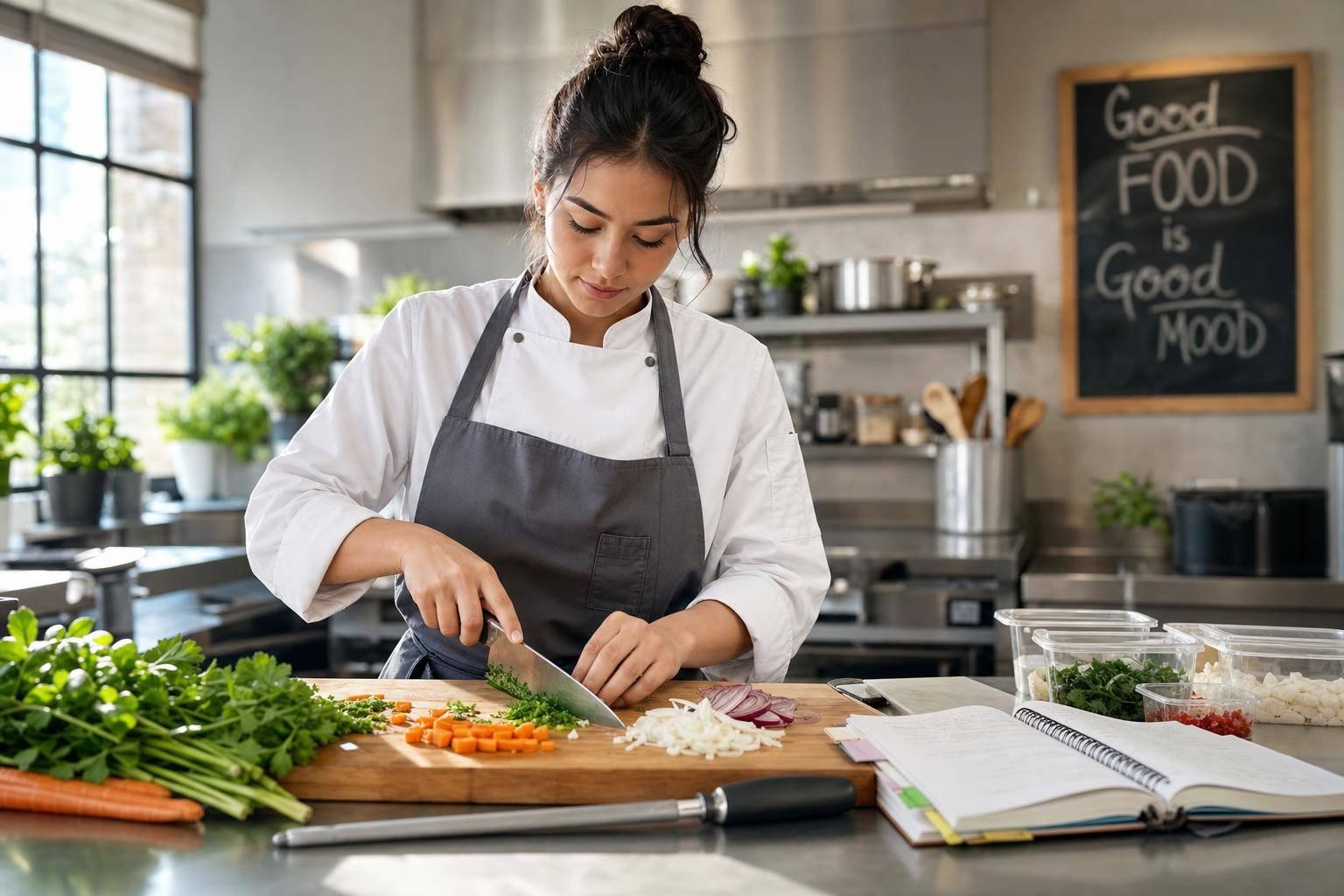
Knife work in culinary school is not a warm-up. It is a benchmark. Consistency, speed, accuracy, and safety are all wrapped into those repetitive cuts. In many programs, students are graded on precision because precision affects cooking time, presentation, and team efficiency.
This can be eye-opening for home cooks who have mostly improvised in their own kitchens. In school, "close enough" often isn’t enough.
Why this matters professionally
Uniform cuts are not just cosmetic. They influence:
- even cooking
- portion control
- plate consistency
- waste management
- kitchen timing
In other words, knife work is where craftsmanship becomes measurable.
How to prepare now
Before school starts, practice:
- basic grip and body positioning
- julienne, brunoise, dice, chiffonade, and batonnet
- sharpening and honing
- efficient workstation setup
The video makes one point especially clear: a dull knife makes everything harder. That’s not just about comfort. It affects speed, quality, and safety.
Graduation Does Not Guarantee the Job You Want
One of the most important corrections in the video is about career expectations.
Many students enter culinary school imagining a direct jump into leadership roles. In reality, graduation more often gives you a foot in the door than a fast pass to the top.
Even with formal training, many new graduates begin as line cooks or in other entry-level positions. That can feel discouraging if you expected the diploma alone to change your status. But in kitchen culture, experience still carries enormous weight.
Why the gap exists
Restaurants hire for more than technical promise. They also look for:
- reliability under pressure
- speed during service
- teamwork
- stamina
- ability to take direction
- consistency over time
School can simulate pressure, but real service tests it differently.
Practical takeaway
If you’re considering school, build a plan for the first 2–5 years after graduation. Think through:
- likely starting wages
- city cost of living
- transportation
- schedule demands
- whether you may need roommates or supplemental income
The video notes that early kitchen pay can be modest. That financial reality should be part of your decision before you enroll, not after.
A Diploma Doesn’t Automatically Make You a Chef
This is one of the strongest opinion-driven themes in the video, and it deserves attention.
The speaker argues that the title "chef" is not something granted by a certificate alone. It is earned over time through competence, leadership, trust, and the respect of others in the industry.
That perspective reflects a long-standing kitchen truth: technical skill is only one part of professional maturity.
A true kitchen leader may need to be:
- a teacher
- a problem-solver
- a manager
- a mentor
- a communicator
- someone who keeps the team functioning when everything goes sideways
For students, this is a healthy reminder. Culinary school may help you become more employable and more skilled, but it does not complete the journey. It starts it.
Why this matters for mindset
If you approach school trying to prove you already belong at the top, you may resist the very feedback that helps you grow.
If you approach school as an apprenticeship in humility and standards, you’re more likely to improve quickly.
Culinary School Can Distort Your View of Real Restaurant Resources
A subtle but valuable insight in the video is that culinary school may give students access to premium ingredients they won’t regularly see in early professional jobs.
That can create an odd transition.
In school, students may work with luxury proteins, specialty items, imported vinegars, or high-end pantry ingredients. In actual restaurants, menu decisions are constrained by:
- food cost
- labor cost
- spoilage risk
- vendor pricing
- rent and overhead
- customer demand
This is not a criticism of culinary school. Exposure to excellent ingredients has real educational value. But students should understand that restaurant cooking is often less about ideal ingredients and more about making smart, profitable decisions with what’s available.
A smart way to think about it
Use school to learn how exceptional ingredients behave, but also ask:
- How would this dish work at scale?
- Could this be produced profitably?
- What would be a practical substitute?
- How does quality change under budget pressure?
That bridge between education and operations is where many young cooks mature.
Creativity Has Limits in the Real World
Culinary school often encourages invention. The video describes exercises where students create dishes from random ingredients under time pressure – a format that develops adaptability and imagination.
That kind of work can be energizing. It teaches students to think in flavor, texture, timing, and composition.
But the real-world correction comes fast: not every workplace rewards personal creativity right away.
In many kitchens, especially at the beginning of your career, your job is to execute someone else’s vision with precision. That means following systems, standards, and recipes rather than expressing yourself freely.
This is not bad news
It’s actually useful training.
Creative freedom means more when it’s built on:
- technical reliability
- menu awareness
- cost discipline
- understanding of the target customer
- respect for the chef’s concept
Students who expect immediate authorship may feel frustrated. Students who learn when to create and when to execute usually advance faster.
The Financial Question: School vs. Apprenticeship
The video raises an issue that deserves serious analysis: culinary school can be expensive, and apprenticeships may offer a viable alternative.
That doesn’t mean school is the wrong choice. It means it should be a deliberate one.
Formal education can offer:
- structured curriculum
- broad exposure
- instructor feedback
- credential value
- peer network
- access to equipment and ingredients
An apprenticeship or on-the-job path can offer:
- lower cost
- immediate real-world experience
- direct mentorship
- income while learning
- earlier adaptation to industry pace
Neither path is automatically better. The right choice depends on your goals, finances, learning style, and access to good mentors.
Questions to ask before choosing
- Am I seeking a recognized credential?
- Do I learn best in structured environments?
- Can I afford tuition without taking on harmful debt?
- Is there a high-level chef or operation willing to train me well?
- Do I want broad foundation first, or direct immersion?
For veterans, career changers, and budget-conscious students especially, this comparison is essential. The best path is not always the most traditional one.
You Will Know Less Than You Think After Graduation
One of the most mature observations in the video is that culinary school can leave graduates realizing how much they still don’t know.
That realization is not failure. It is a sign of growth.
Many programs emphasize French and Italian foundations, which remain influential in professional training. But the food world is far larger than any one curriculum. Graduates quickly discover gaps in their knowledge of global cuisines, regional traditions, and cultural food histories.
Why this matters today
In the U.S. food industry, cultural fluency matters more than ever. Diners are more informed, ingredients are more accessible, and culinary careers increasingly cross cuisines and formats.
A strong graduate should leave school with:
- respect for foundational technique
- curiosity about what they have not yet learned
- willingness to study beyond the curriculum
The video’s underlying point is worth repeating: culinary knowledge is not a destination. It is a lifelong expansion.
Some of Your Best Teachers Will Be Your Classmates
This may be the most underestimated advantage of culinary school.
The video points out that a large share of learning comes not from chef instructors but from peers. That makes sense. A class may include students from different states, countries, family traditions, and work backgrounds. Each person brings habits, flavor references, and techniques that no single curriculum can fully contain.
For students interested in culinary entrepreneurship or broad food literacy, this peer exchange can be invaluable.
How to make the most of it
- Ask classmates about the foods they grew up with
- Trade prep methods and ingredient knowledge
- Taste widely and respectfully
- Observe how others solve the same assignment differently
- Build professional relationships, not just casual friendships
In a field built on collaboration, your classmates can become future colleagues, referral sources, business partners, or creative sounding boards.
School Is One of the Best Places to Make Mistakes
The video makes an important distinction between school and professional kitchens: in school, failure is often recoverable.
That matters because cooking competence develops through correction, not perfection.
When students ruin a batch, miss a texture, or overcook a component, they are learning with a safety net. In restaurants, the stakes are different. Time, product, guest expectations, and labor all make mistakes more costly.
Why this should change how you learn
Don’t waste school by trying only to avoid visible errors. Use it to test, fail, and understand.
A productive student asks:
- What exactly went wrong?
- Was the issue timing, seasoning, temperature, or method?
- How can I correct it next time?
- What does this mistake teach me about process?
That mindset turns tuition into real skill development.
The Relationships May Outlast the Training
The final lesson in the video is arguably the most human: culinary school can create friendships and professional bonds that last for decades.
In industries where jobs are demanding and career paths rarely move in straight lines, those relationships matter. They can become sources of:
- encouragement
- referrals
- honest feedback
- technical advice
- emotional support
- career perspective
For aspiring professionals, this is more than sentimental value. Networking in food is often deeply personal. People hire those they trust, recommend those they respect, and collaborate with those whose work ethic they know.
What Future Culinary Students Should Do Before Enrolling
Drawing from the video’s themes, here is a practical pre-enrollment checklist.
1. Audit your expectations
Be honest about why you want to go. Passion is important, but it won’t answer questions about cost, schedule, or career entry.
2. Compare multiple learning paths
Look at degree programs, certificate programs, apprenticeships, and direct kitchen work. The best option depends on your goals.
3. Budget for the early years, not just tuition
Think beyond school costs. Consider likely starting pay and how long it may take to reach financial stability.
4. Build foundational skills now
Practice knife work, mise en place, sanitation habits, and basic cooking methods before day one.
5. Prepare to be a beginner again
Even strong home cooks often get humbled in formal training. That’s normal and useful.
6. Commit to lifelong learning
Graduation is not proof that you know the food world. It means you’re ready to keep learning in it.
Conclusion: Culinary School Is a Starting Point, Not a Shortcut
The video’s central message is refreshingly honest: culinary school can be inspiring, demanding, expensive, creative, humbling, and transformative – but it is not magic.
It won’t guarantee a dream job. It won’t instantly make you a chef. It won’t teach every cuisine or remove the hard realities of restaurant work.
What it can do is give you a foundation: technique, repetition, feedback, exposure, community, and a clearer understanding of what the profession actually asks of people.
For the right student, that foundation is powerful. The key is to enter with open eyes.
If you’re considering culinary school, the best preparation is not just improving your cooking. It’s understanding the life and work that come with the education.
Source: "Culinary School SHOCKING Secrets Nobody Tells You" – Chef Billy Parisi, YouTube, Aug 15, 2025 – https://www.youtube.com/watch?v=Y5wg86-b0V4