




Salt is more than just a seasoning – it’s a game-changer in cooking. It doesn’t simply make food salty; it transforms how flavors are perceived, balances bitterness, and amplifies sweetness and umami. Salt also boosts aroma, improves texture, and plays a key role in cooking processes like osmosis and the Maillard reaction.
Key takeaways:
- Balances flavors: Suppresses bitterness, enhances sweetness, and highlights umami.
- Boosts aroma: Increases volatile compounds, making food smell and taste more intense.
- Improves texture: Strengthens gluten in bread, retains moisture in meats, and crisps vegetables.
- Timing matters: Early salting allows deeper flavor penetration, while finishing salts add texture and bursts of flavor.
- Crystal size impacts use: Fine salts dissolve quickly, while coarse or flaky salts are ideal for finishing.
Understanding salt’s science helps you create dishes that taste vibrant and balanced. From choosing the right type of salt to mastering when and how to use it, every pinch contributes to a better dish.
Science: When to Add Salt During Cooking – and Why (It Makes a Huge Difference)
How Salt Affects Taste and Aroma
Let’s dive into how salt transforms flavor, focusing on the fascinating science behind its impact on taste and aroma.
The Science of Taste Perception
Salt interacts with your taste buds in a way that’s completely different from how sweetness or bitterness is detected. Sweet and bitter flavors depend on "lock-and-key" protein receptors on the surface of cells. Salt, however, uses ion channels – tiny pathways that allow sodium (Na⁺) and chloride (Cl⁻) ions to flow directly into taste receptor cells [1][7]. This process changes the cell’s electrical charge, sending an immediate signal to your brain.
This specialized detection system makes us highly attuned to salt. Interestingly, humans are about 10 times more sensitive to sour flavors compared to salt and an astounding 100 times more sensitive to bitterness [1]. This sensitivity hierarchy likely evolved to help us identify toxins (bitter) and spoiled food (sour) while ensuring we maintain the right balance of electrolytes (salty).
How Salt Balances Flavor
Salt does more than make food taste salty – it serves as a flavor enhancer and balancer. Sodium ions can suppress bitter flavors by interfering with bitter taste receptors, allowing more pleasant flavors like sweetness to shine through [5]. As researchers P. A. S. Breslin and G. K. Beauchamp explain:
"Salts selectively filter flavours, such that unpleasant tastes (such as bitterness) are more suppressed than palatable ones (such as sweetness) thereby increasing the salience and/or intensity of the latter" [5].
This explains why adding a pinch of salt to dark chocolate or coffee can make them taste sweeter without any added sugar. By blocking bitter signals, salt "unmasks" the underlying sweet and umami notes. Additionally, salt may activate sodium-dependent glucose transporters (SGLT1) in sweet-sensing taste cells, further amplifying the perception of sweetness [4][7]. These effects highlight salt’s unique ability to refine and elevate flavors.
How Salt Boosts Aroma
Salt’s magic goes beyond taste – it also enhances aroma, often before food even touches your tongue. Salt binds with water, lowering water activity. This increases the concentration of volatile aromatic compounds, making them evaporate more easily [4]. As a result, more aroma molecules reach your nose, intensifying the smell – and by extension, the flavor – of food.
The Institute of Medicine (US) Committee on Strategies to Reduce Sodium Intake notes:
"Use of salt decreases water activity… which can lead to an effective increase in the concentration of flavors and improve the volatility of flavor components" [4].
For example, salting meat before cooking doesn’t just season it – it helps release aromatic compounds by interacting with surface moisture. Combined with salt’s ability to suppress bitterness, this effect allows subtle fruity, floral, and savory notes to stand out in dishes like roasted vegetables or grilled steak. Salt’s role in amplifying both aroma and flavor is truly transformative.
Types of Salt and How to Choose
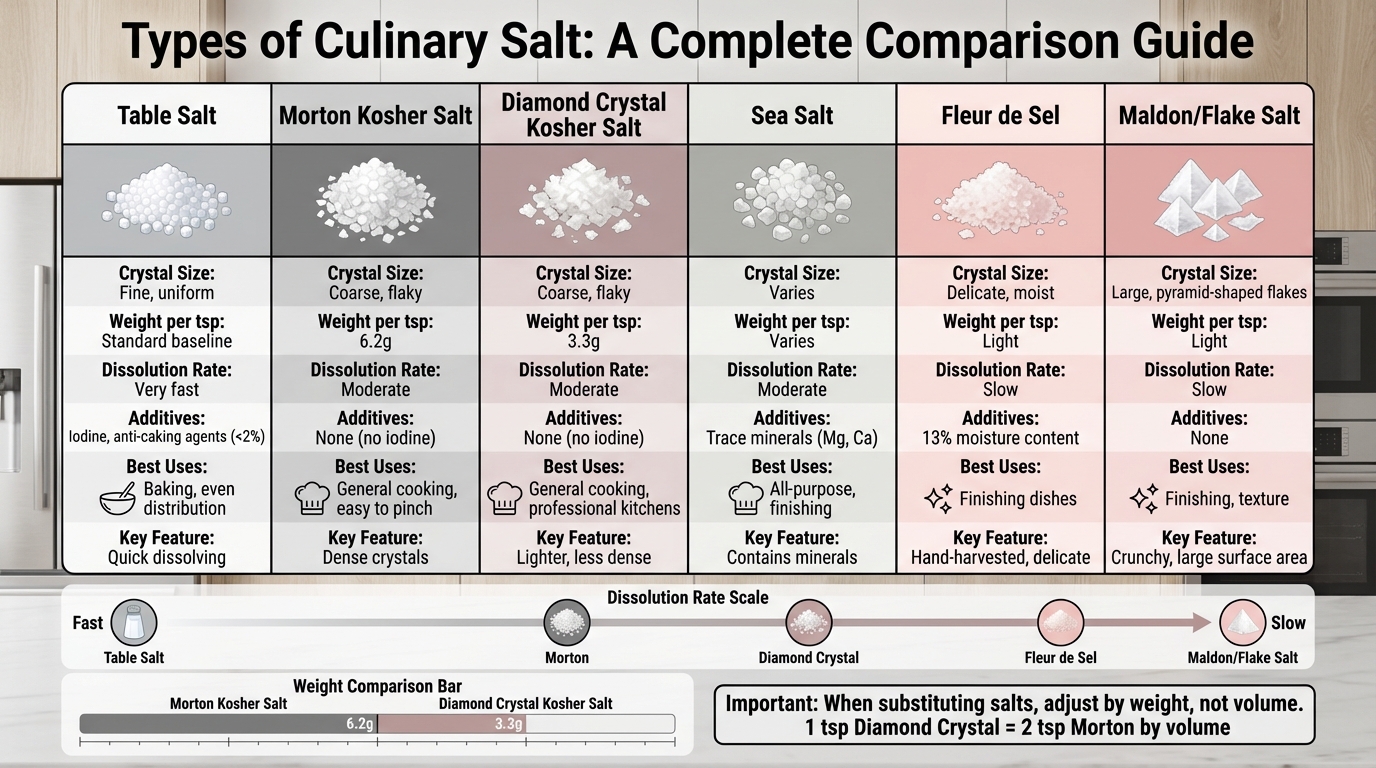
Types of Culinary Salt: Crystal Size, Weight, and Best Uses Comparison Chart
Common Types of Culinary Salt
Understanding the different types of salt and their physical forms can make a big difference in how you use them in cooking. Table salt is made up of fine, uniform crystals that dissolve quickly. It often includes anti-caking agents (less than 2%) and added iodine, making it a staple in baking where even distribution is key [9].
Kosher salt is a favorite among chefs because of its coarse, flaky texture, which makes it easy to pinch and control. It typically doesn’t contain iodine or anti-caking agents, giving it what many describe as a "cleaner" flavor [8][9][10]. However, not all kosher salts are the same – Morton Kosher Salt is denser than Diamond Crystal. For example, 1 teaspoon of Morton weighs 6.2g, while 1 teaspoon of Diamond Crystal weighs only 3.3g [2][3].
Sea salt is harvested from evaporated seawater and contains trace minerals like magnesium and calcium that can subtly influence its flavor and color [8][9][11]. High-end varieties include Fleur de Sel, a hand-harvested finishing salt with a delicate crunch and high moisture content (French gray sea salt, for instance, has about 13% moisture). Another popular option is Himalayan pink salt, mined in Pakistan’s Khewra Salt Mine. Its pink hue comes from iron oxide, and it contains around 37% sodium, slightly less than the 40% found in standard table salt [10].
Flake salts, such as Maldon, have thin, pyramid-shaped crystals with a large surface area. They’re perfect for finishing dishes, adding a satisfying crunch and burst of flavor [8][9][10]. For specific uses, pickling salt is finely ground and free of additives to prevent brine from becoming cloudy, while Kala Namak (black salt) contains sulfur compounds that give it an "eggy" aroma, making it a favorite in vegan recipes [9][10][11].
Crystal Size and Dissolution Rates
The size and shape of salt crystals play a big role in how they season food. Smaller crystals have more surface area relative to their volume, which means they dissolve faster in liquids or on moist surfaces [2][13]. This is why fine table salt disappears almost instantly, while coarse kosher salt takes a bit longer to dissolve.
Density also matters. A teaspoon of one salt can weigh nearly double that of another, so it’s important to adjust measurements when substituting. For instance, if a recipe calls for Diamond Crystal but you’re using Morton Kosher or table salt, you’ll need to use only half the volume [6].
Flaky salts, with their irregular crystals, stick better to foods like proteins and vegetables compared to the smooth, cubic structure of table salt [6][13]. Larger, coarser crystals like Maldon don’t dissolve immediately, offering bursts of flavor and texture when sprinkled on finished dishes [3]. As Cal Peternell, a cookbook author, puts it:
"Using a salt shaker is a mistake… It’s hard to gauge how much you’re using and impossible to get a tactical feel for what properly seasoning… means to you" [6].
By understanding these characteristics, you can choose the right salt to enhance flavor in your cooking.
Additives and Mineral Content
The composition of salt also impacts its taste. Iodized salt, designed to prevent iodine deficiency, may carry a slight metallic taste. Because of this, many chefs prefer non-iodized salts for a more neutral flavor [14][9]. If your diet includes iodine-rich foods like seafood or dairy, you probably don’t need iodized salt and can opt for non-iodized varieties to improve your dishes [16][9].
Natural salts often contain trace minerals that can subtly affect flavor. However, most salts are still about 95% to 98% sodium chloride [9].
It’s worth noting that unrefined salts can sometimes have contaminants like heavy metals, including lead or nickel, due to environmental factors at the harvest site. One study found that all 10 gourmet salts tested exceeded recommended lead levels [15]. For everyday cooking, stick with a reliable option like kosher salt and save specialty salts like Fleur de Sel or Maldon for finishing touches [6].
sbb-itb-7261261
How to Season with Salt
Salt does more than just enhance flavor – it plays a crucial role in how food tastes and smells. But to get the best results, it’s all about knowing when and how to use it during cooking.
When to Add Salt During Cooking
Timing is everything when it comes to salt. Adding it at the right moment can create layers of flavor throughout a dish. For meats and starchy foods, early salting is key because salt takes time to work its way through. For example, it can take up to 24 hours for salt to fully penetrate a refrigerated turkey breast [17]. For proteins, aim to salt at least 40 minutes (or even up to 24 hours) before cooking. This technique, known as dry brining, helps retain moisture while seasoning the meat from the inside out [13].
Seasoning in stages can also make a big difference. Adding salt early to ingredients like onions or mushrooms draws out moisture, which enhances browning through the Maillard reaction [2][13]. As Leah Colins, Senior Culinary Editor at Serious Eats, puts it:
"Salt shouldn’t be used as just a topping… it should be introduced throughout cooking" [2].
For soups, sauces, or braises that reduce significantly, go easy on the salt at first. Since salt doesn’t evaporate, its concentration increases as the liquid reduces [18].
And don’t forget finishing salts. Coarse or flaky salts like Maldon add a final punch of flavor and texture. To avoid uneven seasoning, sprinkle from about 12 inches above the food – this ensures even coverage and prevents overly salty spots [12].
Salting Different Ingredients
Different ingredients call for different salting techniques. For meats and proteins, early salting is best. If you’re working with skin-on poultry, lift the skin and apply salt directly to the meat since the skin can block salt from penetrating [12]. For shell-on shrimp, a quick brine with salt dissolved in liquid ensures even seasoning [12].
Vegetables often benefit from early salting too. For example, salting cabbage or eggplant draws out moisture, which improves texture and crispness [2][3]. When cooking starches like pasta, potatoes, or beans, always salt the water at the start – season it until it’s “as salty as the sea” so the starch absorbs the flavor as it cooks [13].
Baked goods are another story. Salt is added during the mixing phase to strengthen gluten, which improves the structure and chewiness of bread [2][3].
With the right approach for each ingredient, you’ll set the stage for a perfectly balanced dish.
Balancing Salt with Other Flavors
The ideal salinity level for most dishes falls between 1% and 2% by weight compared to the other ingredients [2]. But what happens if you overdo it? You can dilute the dish with unsalted stock or water, add more vegetables or grains to absorb the excess, or balance the saltiness with acid (like lemon juice or vinegar) or fat (such as olive oil or butter) [2][13]. If your dish tastes flat, it probably needs a pinch more salt – add it gradually, tasting as you go.
Salt doesn’t just add flavor – it also works with other tastes. It suppresses bitterness, making sweet and savory flavors stand out, which is why even desserts often include a pinch of salt [3]. It also reduces the sourness of acidic ingredients, making sharp flavors more balanced. As Amie Sue, Culinary Instructor and Author at Nouveau Raw, explains:
"Salt provides a balance between the sweetness and acidity by decreasing the sourness of acid and increasing the sweetness of sugar" [19].
If you forgot to add salt earlier in the cooking process, don’t dump the full amount in at the end – it’s likely to taste too salty. Instead, start with about a quarter or a third of the intended amount and adjust slowly [17]. And remember, salt works beautifully with umami-packed ingredients like soy sauce, miso, or mushrooms to bring everything together into a harmonious dish.
Learning Salt Techniques at Park City Culinary Institute

Hands-On Seasoning Training
At Park City Culinary Institute, students dive into intensive, hands-on training in professional kitchens, where seasoning becomes second nature. The curriculum incorporates the science of seasoning, focusing on salt’s role in managing moisture and enhancing flavor concentration [20][3][22].
Throughout their training, students are encouraged to taste and adjust salt levels at every stage of cooking. This practice helps them find what instructors describe as the "sweet middle ground", where flavors are vibrant without being overly salty [13][2]. Chef instructors, with years of professional experience, provide guidance and feedback, ensuring students learn how to apply these principles effectively in real-world scenarios [3][20].
This foundational knowledge naturally leads to advanced techniques, such as layering flavors for more complex dishes.
Combining Salt with Aromatics and Umami
Once students have mastered the basics of seasoning, they move on to more creative techniques, exploring how salt interacts with aromatics and umami-rich ingredients. The Cuisine Program emphasizes flavor building and flavor profiles, teaching students how to enhance dishes by combining salt with ingredients like meat, poultry, and seafood [20][21].
Students practice layering salt with umami-packed elements such as anchovies, cheeses, and soy sauce. These techniques help them create flavors with depth when added early in the cooking process and brightness when added later [20][3][13].
"Salt interacts directly with taste receptors, amplifying sweetness and umami while muting bitterness" [3].
Applying Salt Science in Professional Kitchens
The institute goes beyond flavor theory, preparing students to apply their knowledge of salt in professional kitchen environments. The Professional Certificate in the Culinary Arts (216 hours) covers both cooking and baking, offering a well-rounded understanding of how salt works across various dishes [20][21]. With chef instructors averaging over a decade of industry experience, students gain practical insights and techniques they can carry into their careers.
Park City Culinary Institute’s reputation speaks for itself, having won Best of State in Culinary Education for four years straight (2019–2022). Its alumni include notable names like the founders of Kodiak Cakes and Crumbl Cookies [20]. Whether students aim to excel in professional kitchens or launch their own food ventures, they leave with a deep understanding of using salt as a cornerstone for crafting balanced and flavorful dishes.
Conclusion
Salt does much more than simply make food taste better – it changes ingredients at their very core[3]. By digging into the science of salt, it becomes clear why it intensifies flavors, bringing out the best in each component of a dish[13].
The timing of seasoning is just as important as the salt itself. Adding salt early allows it to fully integrate, while layering it throughout the cooking process creates depth and complexity that a last-minute sprinkle just can’t achieve[2][12]. Whether it’s drawing out moisture through osmosis, enhancing aromas, or balancing bitterness to let sweetness and umami shine through[3][5], every pinch of salt has a job to do. As Leah Colins, Senior Culinary Editor at Serious Eats, puts it:
"Season to taste isn’t a vague suggestion, it’s a fundamental cooking technique." – Leah Colins[2]
From its role in diffusion to boosting aromas, salt proves time and again to be an essential tool in the kitchen. Most people’s taste buds are naturally tuned to enjoy a salinity level between 1% and 2% by weight[2]. Using a reliable salt like Diamond Crystal Kosher, sprinkling it evenly from about 12 inches above the dish, and tasting as you go are small habits that make a big difference in your cooking[6][12].
Mastering the use of salt isn’t about making food overwhelmingly salty – it’s about letting every ingredient shine. Armed with this understanding, you can season with confidence, creating dishes that are well-balanced, vibrant, and truly unforgettable.
FAQs
How does salt bring out the flavors in sweet and savory dishes?
Salt plays a key role in enhancing flavors by creating balance and depth. In sweet dishes, it works to tone down bitterness, allowing the sweetness to shine through and become more enjoyable. In savory or umami-packed recipes, salt interacts with compounds like glutamate, enriching the dish’s savory notes and making the flavors more pronounced. This unique ability to harmonize and elevate tastes is why salt remains a cornerstone of cooking.
Why does the timing of adding salt matter in cooking?
The moment you choose to add salt can make or break the flavor and texture of your dish. When you salt early in the cooking process, it dissolves and works its way into the ingredients, seasoning them evenly from the inside out. This approach ensures the entire dish has a consistent, well-rounded flavor rather than just a salty outer layer.
Salt doesn’t just impact flavor – it also plays a big role in texture. For instance, salting meat ahead of time locks in moisture, improves browning, and helps develop a delicious crust. With vegetables, salting before roasting pulls out excess water, intensifies their natural sweetness, and encourages caramelization. On the other hand, adding salt too late often leads to uneven seasoning and textures that fall short of their potential.
At Park City Culinary Institute, students dive into these techniques through hands-on practice, learning how to harness salt’s power at just the right moments to craft dishes that are perfectly seasoned and full of flavor.
What are the different types of salt, and how are they used in cooking?
Salt comes in many forms, each bringing its own flair and functionality to the kitchen. Table salt, with its fine grains and quick-dissolving nature, is the go-to for baking and recipes requiring precise measurements. Kosher salt, known for its coarse, flaky texture, is easy to pinch and sprinkle, making it a favorite for seasoning meats, vegetables, and dishes as they cook. Sea salt, derived from evaporated seawater, adds a subtle depth of flavor and shines as a finishing touch on salads, fish, or even desserts.
For an extra crunch, flake salts like Maldon are perfect for topping roasted vegetables or steaks. Himalayan pink salt, with its signature rosy hue, not only enhances presentation but also delivers a unique flavor. Meanwhile, Kala Namak – a salt with a distinct sulfuric, egg-like taste – is often used to elevate vegan dishes. Pickling salt, which dissolves effortlessly, is ideal for preserving foods, while rock salt finds its place in ice cream makers or for creating dramatic serving displays.
At Park City Culinary Institute, students explore the art of using these salts to amplify flavors and create harmony in their dishes. By balancing sweetness, acidity, and bitterness, they turn ordinary ingredients into unforgettable culinary experiences.
Curious how chefs use salt, acid, and heat? Seasoning and savory technique are at the heart of our Cuisine Certificate. Join a hands-on cooking class, study online, or request info.