

Private chefs do more than just cook – they help individuals and families manage specific health needs through personalized meal preparation. From addressing severe allergies to creating meals for chronic conditions like diabetes or cancer, their role combines culinary expertise with health-focused planning. Here’s how they do it:
- Consultation: Private chefs start with a detailed discussion about dietary restrictions, allergies, health goals, and meal preferences.
- Meal Planning: They design custom menus tailored to individual needs, balancing flavor and nutrition while adhering to strict dietary protocols.
- Ingredient Sourcing: Chefs carefully select ingredients, often from local or specialty suppliers, and use substitutions to meet dietary requirements.
- Safety Measures: For clients with allergies, they implement strict protocols to prevent cross-contamination.
- Collaboration: Many chefs work with doctors, nutritionists, and trainers to align meals with broader health goals.
Private chefs differ from personal, family, and restaurant chefs in their focus on one household, offering daily, real-time adjustments to meals. While personal chefs prepare batch meals for multiple clients, and restaurant chefs cater to a broad audience with limited customization, private chefs provide full-time, tailored service. This makes them ideal for those with complex health needs or performance-driven diets.
Hiring a private chef is an investment, with annual costs ranging from $30,000 to over $100,000, but it ensures consistent, personalized care in the kitchen. Whether managing severe allergies or optimizing nutrition for recovery or athletic performance, private chefs offer a solution that prioritizes health and peace of mind.
1. Private Chefs
Consultation and Assessment
When working with a new client, private chefs kick things off with a detailed consultation to uncover food preferences and gather critical health information. This process often involves reviewing medical histories to pinpoint allergies, intolerances (like soy or dairy), and specific dietary needs, such as AIP, Low FODMAP, or renal-friendly protocols [1][4]. Beyond health, chefs assess whether the client requires meals tailored for athletic performance, managing chronic conditions like diabetes or cancer, or even post-surgery recovery [10][11][12].
Practical details also come into play during these discussions. Chefs and clients talk about meal styles (e.g., formal plated dinners versus casual family-style), how often meals should be prepared, grocery budgets, and the kitchen setup [2]. As Christian Paier, founder of Private Chefs Inc., puts it:
A private chef affords that guarantee [of health] without having to think about it [12].
This in-depth consultation lays the groundwork for creating fully customized meal plans.
Meal Planning and Customization
Once the assessment is complete, private chefs design meal plans that balance dietary restrictions with flavor and presentation. A great example of this is Neil Zevnik, a self-taught private chef who, in 1993, helped Elizabeth Taylor lose 30 pounds in about 14 weeks by preparing healthy, satisfying dishes that aligned with her weight loss goals [12].
To keep meals flavorful despite restrictions, chefs use creative ingredient swaps. For instance, they might lean on ginger for its anti-inflammatory properties, use coffee-based dry rubs to cut down on salt, or craft fat-free herb sauces like chimichurri [12]. David Wells, a private chef who studied nutrition after his mother’s ovarian cancer diagnosis and has cooked for high-profile clients like Steve Jobs and George Lucas, explains:
Select the right ingredients and use them in an artful way, and a chef can elevate flavor without all the fat and empty calories. Cooking is as much a science as it is an art [12].
Ingredient Sourcing and Substitution
Private chefs often go the extra mile by sourcing fresh, seasonal ingredients directly from specialty suppliers, farmers, and local markets to meet their clients’ dietary needs [10]. For clients with severe allergies, they follow strict safety measures – carefully reading food labels, using separate utensils, and labeling leftovers to avoid cross-contamination [4].
Advanced substitution techniques also play a big role in maintaining taste and texture. For example, celery root purée can replace butter or cream, delivering richness while adhering to dietary restrictions [10][12]. Chef Scott Wuennemann highlights the shift in modern cooking:
In classical cooking you need eggs, cream, and plenty of fat, but the modernist approach lends itself to being healthy with techniques that infuse light, bright, crisp flavors without a lot of fat [12].
Collaboration with Health Professionals
Private chefs often collaborate with health professionals to ensure meal plans align with broader wellness goals [4]. Some chefs even hold dual certifications as culinary experts and registered dietitians, earning them the title "private chef nutritionist" [4]. For example, in 2015, chef Scott Wuennemann partnered with doctors and nutritionists at the Cleveland Clinic to create a meal plan for an obese client, leading to significant weight loss [12].
This teamwork turns clinical advice into practical, long-term meal strategies for managing conditions like diabetes and autoimmune disorders [4]. Chef Cynthia Walt recalls:
Sometimes he was irritated to see me because that meant he had to eat well, but I liked the challenge of making meals that were restricted yet still delicious [12].
2. Personal Chefs
Consultation and Assessment
Personal chefs differ from private chefs in that they cater to multiple clients rather than serving just one household. Typically self-employed, they prepare meals in advance for clients to enjoy later [14][7]. The process begins with a detailed consultation, where chefs discuss dietary preferences and nutritional goals [1]. This meeting covers everything from dietary restrictions and lifestyle choices – like vegan, paleo, or ketogenic diets – to practical details such as meal preferences, scheduling, budget, and kitchen setup [2][13].
To streamline this process, many chefs rely on digital tools to track preferences, including favored and disliked ingredients, preferred cooking techniques, and spice levels [13]. These tools help create a strong foundation for crafting a personalized meal plan that meets each client’s unique needs.
Meal Planning and Customization
Personal chefs often use a “base plus customization” strategy. This involves preparing a versatile base dish and then tailoring it with specific additions to suit individual household members [15]. This approach is especially important, as over 85% of American households have at least one member with specific dietary needs [15].
To ensure safety, chefs follow strict protocols to avoid cross-contamination. These include using color-coded cutting boards, separate prep stations, and dedicated utensils for allergen-free cooking [15][4]. Regular check-ins, held weekly or monthly, allow chefs to refine menus based on client feedback and adjust to any changes in dietary requirements [13][2].
Ingredient Sourcing and Substitution
Once menus are customized, chefs focus on sourcing top-quality ingredients, often from local markets, while carefully monitoring the "Big 8" allergens to avoid accidental exposure [4][14][15][16].
To simplify meal preparation, chefs use flexible recipe formats like “build-your-own bowls,” sheet pan meals, or stir-fry templates. These frameworks allow for ingredient swaps without requiring entirely separate dishes [15]. Batch cooking is another key strategy, enabling chefs to prepare components like grains, proteins, and roasted vegetables in bulk. These can then be mixed and matched throughout the week to meet various dietary needs [15].
Collaboration with Health Professionals
Personal chefs often collaborate with nutritionists, doctors, and wellness experts to ensure menus align with specific health protocols, such as AIP, SIBO, or Low FODMAP diets [1][4][11]. Health Nut Chefs emphasizes this partnership:
We are happy to collaborate with your nutritionist, doctor, or other wellness professional in crafting menus [1].
Some chefs take their services a step further by offering expertise in "culinary medicine." These chefs not only cook but also provide nutritional guidance, helping clients manage symptoms or food sensitivities [11]. Such specialized services typically cost around $40–$45 per serving [11]. Andrea Sprague, owner of The Holistic Chef, highlights the value of this approach:
Our meals come out to about $40-$45/serving, but what you get in return is priceless (because you can’t put a dollar amount on your health) [11].
For clients with unique nutritional needs, chefs are willing to research and implement unfamiliar protocols [1]. This collaborative approach ensures that meal plans support broader health and wellness goals while adhering to medical recommendations [2][4].
3. Family Chefs
Consultation and Assessment
Family chefs bring a unique advantage to the table: their consistent on-site presence allows them to address dietary needs in real time, offering a highly personalized approach. These chefs work exclusively for a single household, often living on-site and managing all aspects of the kitchen [5][7]. Their service typically begins with a detailed consultation and food preference interview, aimed at understanding the dietary and nutrition goals for every family member [1]. This initial process delves into specifics like food allergies, dietary preferences (such as keto or gluten-free), and sensitivities to certain ingredients [2].
For families with more complex medical requirements, the chef reviews their qualifications and provides sample menus tailored to conditions like diabetes or autoimmune disorders [4]. During this phase, health objectives – whether they involve weight loss, enhanced athletic performance, or post-surgery recovery – are clearly outlined [2][12]. Regular check-ins, conducted weekly or monthly, ensure that the menus remain aligned with any changes in dietary needs [2]. These detailed assessments help chefs develop meal strategies that evolve alongside the family’s requirements.
Meal Planning and Customization
One of the standout skills of family chefs is their ability to create versatile meals that cater to everyone in the household. For instance, they might prepare a base dish – like seasoned rice with roasted vegetables – and offer a variety of proteins such as chicken, tofu, or beans, along with different toppings. This approach allows each family member to customize their meal to suit their taste and nutritional needs. This flexibility is especially valuable, considering that over 85% of American households have at least one member with specific dietary restrictions [15].
To make meal planning efficient, chefs rely on a unified list of ingredients that are safe for everyone and incorporate adaptable meal ideas like "Build-Your-Own Bowl" nights or "One-Sheet Pan Dinners." These strategies not only prevent cross-contamination but also simplify the cooking process. By batch cooking essential components, chefs ensure that meals can be easily mixed and matched throughout the week [15]. Once the menus are finalized, the focus shifts to sourcing ingredients that meet these dietary requirements.
Ingredient Sourcing and Substitution
When it comes to managing severe allergies, family chefs follow rigorous safety protocols to avoid cross-contamination. They use tools like color-coded cutting boards, separate preparation areas, and dedicated appliances to ensure allergen-free cooking environments [4][15]. Special attention is given to the "Big 8" allergens [15].
Chefs source specialty products – such as tamari for a soy-free alternative to traditional soy sauce – from health food stores, ethnic markets, and trusted online retailers. They maintain a "safe brand" list, which is regularly updated since manufacturers can change ingredients over time. To further reduce risks, chefs prepare the most restricted meals first before moving on to dishes containing common allergens [15].
Collaboration with Health Professionals
Family chefs often collaborate closely with doctors, nutritionists, and other wellness experts to ensure that the meals they prepare align with specific dietary or medical guidelines [1][4]. In some cases, chefs also serve as nutritionists, blending their culinary expertise with personalized dietary advice [4]. As Health Nut Chefs explains:
We are happy to collaborate with your nutritionist, doctor, or other wellness professional in crafting menus [1].
For example, in August 2015, chef Scott Wuennemann worked with physicians and nutritionists at the Cleveland Clinic to create a nutrient-rich meal plan for a client dealing with obesity, which led to significant weight loss [12]. In another instance, chef David Wells developed a specialized diet for his mother during chemotherapy, focusing on raw phytonutrients and complex carbohydrates to aid her recovery from ovarian cancer [12].
Chefs maintain open communication with families to adjust menus as health needs change [8]. When faced with unfamiliar dietary protocols, they conduct thorough research to ensure they meet the family’s expectations accurately [1].
4. Restaurant Chefs
Consultation and Assessment
When it comes to dietary needs, restaurant chefs typically rely on information passed along by servers rather than engaging in direct conversations with diners. To make things smoother, guests are encouraged to inform the restaurant about any dietary restrictions when making a reservation [17]. This early notice allows chefs to adjust their preparation routines in advance. As Daniel Myers, Co-owner of Loyal Nine, shares:
If you let us know you’re a vegan, we can make sure not to cook our turnips in chicken stock when we prep them that morning [17].
Without such advance notice, the kitchen may struggle to adapt on the fly. Rochelle Bilow, Senior Associate Web Editor at Bon Appétit, highlights the challenge:
A restaurant kitchen is a well-oiled machine that’s set up for maximum efficiency – not surprises [17].
This streamlined communication system is a stark contrast to the more personalized, in-depth consultations typically offered by private or family chefs.
Meal Planning and Customization
Restaurant kitchens are built to handle high volume and maintain consistency, which often limits their ability to cater to highly specific requests. Menus are pre-planned, with dishes prepared and portioned ahead of time. While minor adjustments – like leaving off a garnish or swapping out a protein – are usually feasible, more complex changes can be tricky. Dan Winkley, Manager at The Dining Room at the White Hart Inn, explains:
Chefs may cringe a little bit if you ask to swap out a protein, but it’s a relatively easy ask [17].
However, certain customizations are simply not possible. For instance, pre-prepped components, such as a ragù, can’t be altered during service. As Myers puts it, asking to remove meat from a ragù is "generally impossible during service" [17]. In such cases, chefs often assemble dishes using available components rather than creating something entirely new to meet dietary restrictions.
Ingredient Sourcing and Substitution
Restaurant chefs work with the ingredients they have on hand, leaving little room for special orders or substitutions [17]. For example, if a diner requests chipotle mayo but the kitchen doesn’t stock chipotles, the request can’t be fulfilled. Substituting ingredients not already included in the menu can also disrupt food costs and inventory. Myers points out that using stock intended for other dishes to accommodate a special request can throw off the kitchen’s careful planning. This approach differs significantly from that of private chefs, who shop specifically to meet their clients’ needs.
Collaboration with Health Professionals
Due to the fast-paced nature of restaurant service and limited guest interaction, restaurant chefs rarely collaborate with health professionals to create tailored dietary plans [17]. The brief exchanges between diners and the kitchen, often mediated by servers, don’t allow for the detailed discussions needed for specialized diets. For guests with extensive dietary restrictions, Myers suggests:
a written list of restrictions if they are more than 10 items [17].
This practical solution helps streamline communication and ensures the kitchen can accommodate as best as possible within its constraints.
sbb-itb-7261261
5 things you should know about being a private or personal chef
Strengths and Limitations
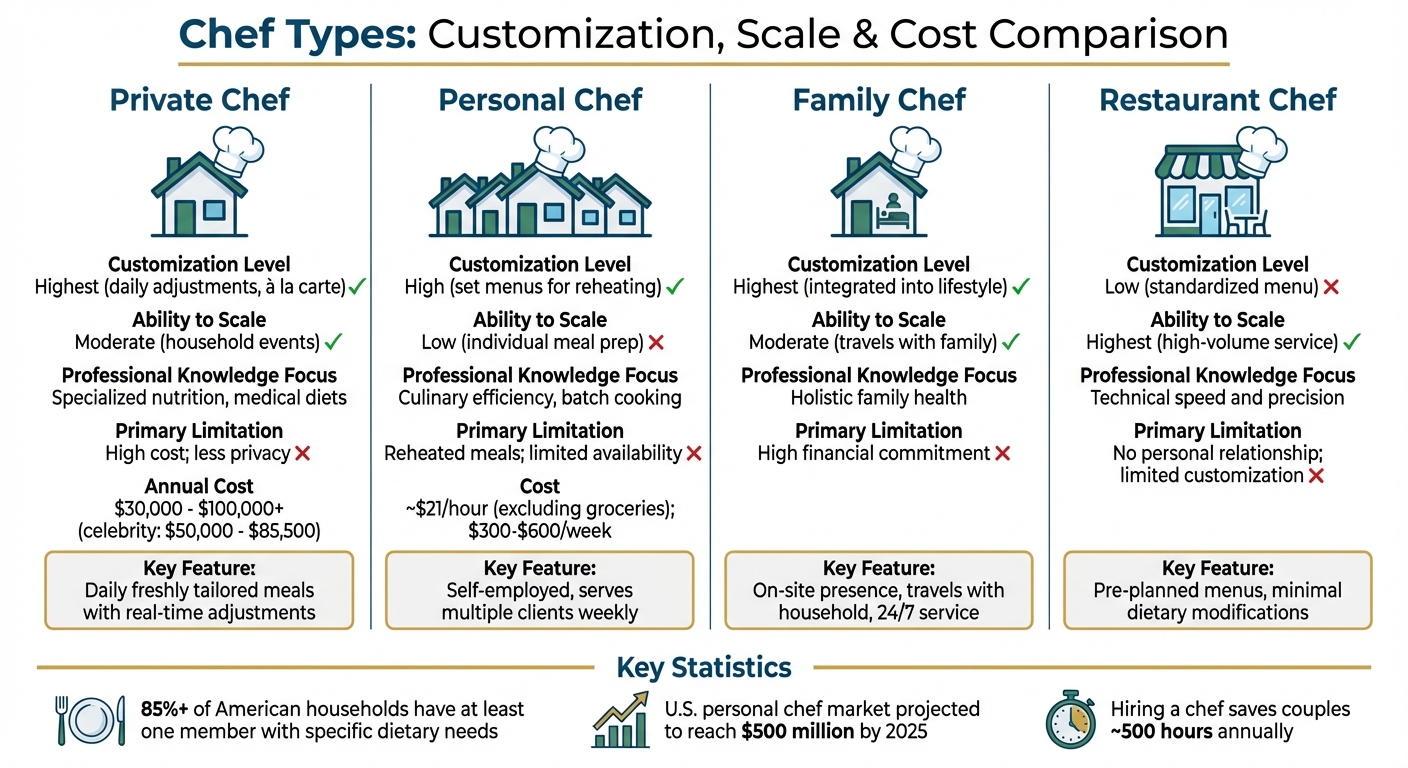
Comparison of Private, Personal, Family, and Restaurant Chefs for Dietary Needs Management
Different types of chefs bring their own set of perks and challenges when it comes to customization, cost, and service. Private chefs, for instance, offer an unmatched level of personalization by crafting daily menus tailored to real-time health data. However, this comes with a hefty price tag – annual salaries range from $30,000 to over $100,000, and celebrity engagements can cost between $50,000 and $85,500 per year [3]. As Parx Home Health Care puts it:
Private chefs are like food whisperers. They get to know you, your likes, dislikes, and any dietary quirks you might have. [18]
Personal chefs, on the other hand, provide a more budget-friendly option, charging around $21 per hour in the U.S. (excluding grocery expenses) [18]. They usually serve multiple clients, visiting homes once or twice a week to prepare meals that can be reheated later [6]. While they can address general health goals and dietary restrictions, their menus are often less adaptable. Jennifer Sweenie from Tasting Table explains:
The main difference between a personal chef and a private chef is that a private chef is typically employed by one person or a family, whereas a personal chef is self-employed and has any number of clients on their roster. [6]
Family chefs function similarly to private chefs but often live on-site and travel with the household, offering round-the-clock service. This arrangement removes the hassle of meal planning and preparation but comes with a significant financial commitment. Meanwhile, restaurant chefs shine in high-volume environments, focusing on technical expertise and speed. However, they generally lack the personal connection and flexibility needed for managing specific, long-term dietary needs [5].
Here’s a quick breakdown of these chef types:
| Chef Type | Customization Level | Ability to Scale | Professional Knowledge Focus | Primary Limitation |
|---|---|---|---|---|
| Private Chef | Highest (daily adjustments, à la carte) | Moderate (household events) | Specialized nutrition, medical diets | High cost; less privacy |
| Personal Chef | High (set menus for reheating) | Low (individual meal prep) | Culinary efficiency, batch cooking | Reheated meals; limited availability |
| Family Chef | Highest (integrated into lifestyle) | Moderate (travels with family) | Holistic family health | High financial commitment |
| Restaurant Chef | Low (standardized menu) | Highest (high-volume service) | Technical speed and precision | No personal relationship; limited customization |
These comparisons highlight the balance between customization, scale, and cost. Depending on your priorities, each chef type offers distinct advantages and trade-offs.
When interviewing a chef, consider requesting a sample 3-day menu to gauge their skills and creativity [4]. If severe allergies are a concern, ensure they have robust safety protocols in place.
Conclusion
Managing complex dietary needs can be challenging, but private chefs offer a unique solution by controlling every detail of the kitchen environment. From carefully sourcing ingredients to managing pantry inventory, they eliminate the cross-contamination risks often found in high-volume kitchens [19][6]. Unlike personal chefs, who typically prepare meals in batches, private chefs provide freshly tailored meals daily, adjusting in real time based on health data [6]. As LiveGreensPDX puts it:
"Hiring a personal chef who understands these needs isn’t about indulgence. It’s about reclaiming peace of mind….knowing every meal on your table is safe, balanced, and built around your health." [8]
Choosing the right chef depends on your specific needs. If you’re managing conditions like diabetes or severe allergies and require daily, freshly prepared meals, a private chef offers the safety and customization necessary [4][21]. On the other hand, if your goal is weekly meal prep for general health, a personal chef may be a better fit, with costs ranging from $300 to $600 per week in cities like Portland [8]. While restaurant chefs are highly skilled in high-pressure environments, they often lack the personalized focus and controlled setting required for long-term dietary care [19]. These distinctions highlight the importance of thoroughly vetting your chef.
Before hiring, check credentials like ServSafe certification and liability insurance, and ask to review sample menus and protocols for preventing cross-contamination [4][8][20]. Clear communication is also key – using tools like shared documents for menu feedback can help fine-tune recipes to match your preferences, whether it’s adjusting salt levels, spice tolerance, or specific ingredients [20].
Hiring a chef isn’t just a luxury – it’s an investment in your health and peace of mind. Professional meal management can save a couple around 500 hours annually – essentially freeing up an entire month of time [9]. With the U.S. personal chef market projected to reach $500 million by 2025 [20], more families are realizing that culinary expertise goes beyond convenience. It’s about ensuring consistency, health, and peace of mind. Personalized meal care doesn’t just meet dietary needs – it supports your overall well-being.
FAQs
What should I consider when hiring a private chef for complex dietary needs?
When bringing on a private chef to manage complex dietary needs, it’s crucial to find someone with formal culinary training, such as a professional certification or degree, along with hands-on experience in crafting meals for specialized diets. Additional education in nutrition or related areas can further highlight their expertise.
Be sure to ask about their history of designing menus for specific requirements – whether it’s gluten-free, vegan, kosher, or other dietary preferences. Also, inquire about their knowledge of ingredient sourcing and how they handle cross-contamination prevention. A great private chef will emphasize clear and open communication to ensure your dietary needs are met with precision and care.
How do private chefs accommodate medical dietary restrictions in their cooking?
Private chefs go above and beyond to craft meals that align with medical dietary needs, tailoring every detail to the client. It all begins with an in-depth consultation to understand allergies, medical conditions, and any specific dietary restrictions. Often, they collaborate directly with doctors or nutritionists to confirm guidelines, relying on written documentation to ensure nothing is overlooked.
Ingredient sourcing becomes a meticulous process, with chefs carefully reviewing labels to ensure compliance. To avoid cross-contamination, they use dedicated tools, utensils, and storage. In cases of severe allergies or highly specific diets, some chefs even establish a "clean zone" in the kitchen for added safety. Many prefer to prepare meals in the client’s home, allowing for real-time adjustments and reducing the risk of exposure to any restricted ingredients.
Communication remains a cornerstone of this process. Chefs provide detailed meal plans, actively seek feedback, and tweak dishes as health needs change. This thoughtful approach – combining careful planning, professional partnerships, and rigorous kitchen practices – ensures every meal is both safe and perfectly suited to the client’s medical requirements.
What’s the difference between a private chef and a personal chef when it comes to managing dietary needs?
A private chef is dedicated to a single household, often living on-site or nearby, and is responsible for preparing every meal specifically tailored to the family’s preferences and dietary needs. Whether it’s managing allergies, creating low-sodium dishes, or following a keto plan, private chefs can adjust menus on the fly to meet even the most complex requirements. Beyond cooking, they take care of grocery shopping, collaborate with household staff, and often travel with the family to ensure consistent, personalized meals no matter where they are.
In contrast, a personal chef works with multiple clients, typically visiting each home once or twice a week to prepare meals in advance. They still customize menus and handle ingredient shopping, but their visits are less frequent. As a result, dietary changes usually need to be planned ahead. This option is more flexible and budget-friendly but may not offer the same level of immediate attention for evolving or detailed dietary needs.
Chefs trained at the Park City Culinary Institute gain practical experience in specialized nutrition and menu planning, preparing them to expertly handle a wide range of dietary preferences in either role.